2026 Best Ceramic Ball Filler Types for Global Buyers
Choosing the right Ceramic Ball Filler in 2026 requires more than comparing price per kilogram. Global buyers must examine composition, particle size, surface finish, thermal stability, and supplier consistency. A ball that appears uniform in a sample may perform differently across a full production batch. Small details matter.
This guide introduces key Ceramic Ball Filler types, including alumina, zirconia, silica, and mullite-based options. Each material serves different needs in coatings, plastics, adhesives, catalysts, and engineered compounds. Alumina often provides strong hardness and heat resistance. Zirconia offers higher density and excellent wear performance, but its cost can be difficult for budget-sensitive projects. Silica-based fillers may improve processing efficiency, yet moisture control deserves close attention.
Real purchasing decisions also depend on certification, traceability, packaging, and technical support. Experienced buyers should request test reports, safety data sheets, batch records, and application references before approving a supplier. Independent testing is valuable when tolerances are tight. It can reveal unexpected dust, uneven sizing, or surface-treatment differences. Not every advertised specification tells the full story. Some suppliers provide impressive numbers without explaining test conditions. That deserves caution.
This overview compares performance, cost, sourcing risks, and practical applications for international markets. It does not assume one filler suits every formulation. That would be misleading. Instead, it highlights where each type performs well and where further validation remains necessary. Careful trials, realistic specifications, and transparent communication can reduce costly surprises in 2026.
Ceramic Ball Filler Basics and Key Industrial Functions
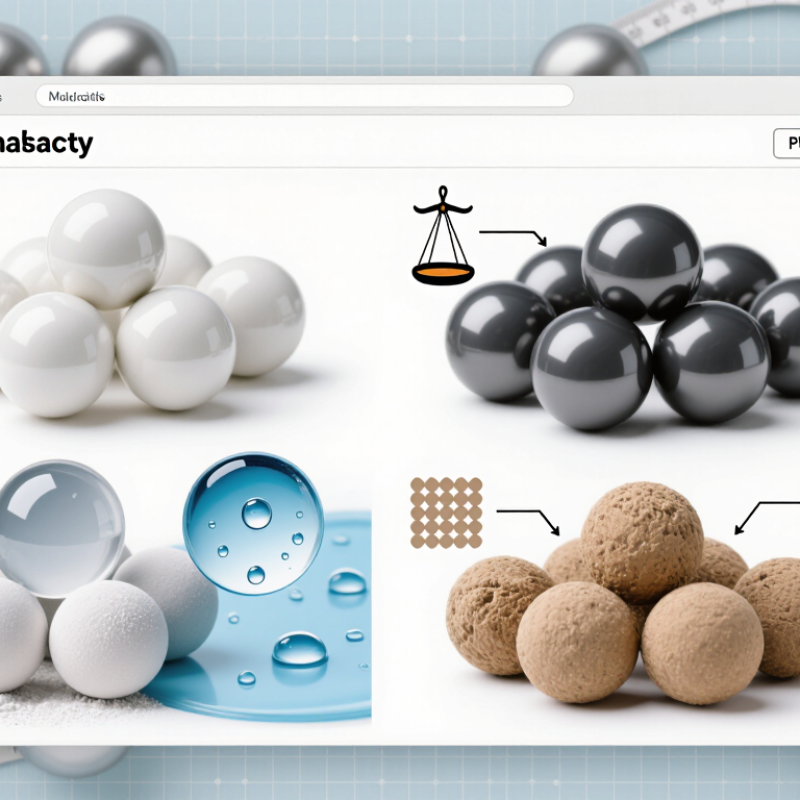
Ceramic ball fillers are engineered particles used to occupy volume, transfer heat, or improve surface performance. Common families include alumina, silica, zirconia, and mixed ceramic compositions. Their value depends on purity, hardness, porosity, and size distribution. A 3 mm dense ball behaves differently from a porous 20 mm piece. This difference matters. In practical selection, buyers should match the filler to temperature, pressure, chemical exposure, and required service life.
Industrial functions vary by application. In heat-treatment systems, ceramic balls can support materials while allowing gas circulation. In reactors and filtration equipment, shaped ceramic media may distribute flow and provide contact area. Dense alumina balls often resist abrasion and high temperatures. Zirconia offers greater toughness, but its cost can rise sharply. Silica-based options may suit moderate thermal conditions, although sudden temperature changes can cause failure.
Reliable purchasing requires more than checking a catalogue description. Request test data for crush strength, water absorption, thermal expansion, and chemical resistance. Inspect dimensions, chipped edges, dust, and batch consistency when samples arrive. Field experience shows that small defects can become pressure points during loading. Yet laboratory data does not predict every installation. Poor packing, vibration, or uneven heating may shorten performance. I would question unusually low prices; they sometimes hide variable density or inconsistent firing. The choice should be reviewed after a trial run, not treated as permanently correct.
| Ceramic Ball Filler Type | Primary Composition | Typical Density | Typical Mohs Hardness | Water Absorption | Temperature Capability | Key Industrial Functions | Best-Fit Applications | Buyer Selection Considerations |
|---|---|---|---|---|---|---|---|---|
| Alumina Ceramic Balls | Aluminium oxide (Al2O3), commonly available in different purity grades | About 3.4–3.9 g/cm³ | About 8–9 | Usually below 0.5% | Up to about 1,500–1,800°C, depending on grade and service conditions | Wear-resistant filler, grinding medium, heat-resistant packing, catalyst-support matrix, and flow-distribution media | Mining, ceramics, cement, chemical processing, petroleum refining, heat-treatment equipment, and wear-protection systems | Choose higher-purity grades for lower contamination and chemical stability; verify bulk density, ball roundness, and thermal-shock requirements. |
| Zirconia Ceramic Balls | Zirconium dioxide (ZrO2), usually stabilized with yttria, magnesia, or ceria | About 5.8–6.1 g/cm³ | About 8–8.5 | Generally below 0.1% | Typically used below about 1,000–1,200°C, depending on stabilizer and design | High-efficiency fine grinding, low-contamination milling, wear-resistant filler, and precision mixing media | Paints, inks, pigments, battery materials, electronic ceramics, advanced ceramics, pharmaceuticals, and high-value chemicals | Offers high density and low wear, but normally has a higher purchase cost; confirm stabilizer type, fracture toughness, and compatibility with the slurry. |
| Silica Ceramic Balls | Silicon dioxide (SiO2), commonly produced from fused or high-silica ceramic materials | About 2.2–2.6 g/cm³ | About 6–7 | Usually below 1% | Approximately 1,000–1,600°C, depending on silica form and thermal cycling | Inert packing, thermal buffering, flow distribution, filtration support, and selected grinding operations | Chemical towers, filtration systems, foundry processes, thermal applications, and general process vessels | Useful where low density and chemical inertness are important; check resistance to alkaline solutions and rapid temperature changes. |
| Steatite Ceramic Balls | Magnesium silicate ceramic, primarily based on talc-derived steatite | About 2.6–2.9 g/cm³ | About 5–6 | Generally below 1% | Usually up to about 1,000–1,200°C | Economical packing, electrical insulation, dimensional support, and light-duty grinding or mixing | Electrical components, chemical processing, low-cost packing beds, and applications requiring moderate mechanical strength | A cost-effective option for moderate wear conditions; it is less suitable than alumina or zirconia for severe abrasion or high-impact milling. |
| Mullite Ceramic Balls | Aluminosilicate ceramic, commonly consisting of 3Al2O3·2SiO2 or a related mullite-rich phase | About 2.5–2.9 g/cm³ | About 7–8 | Usually below 1% | Approximately 1,400–1,700°C, depending on porosity and formulation | High-temperature packing, kiln furniture support, thermal insulation support, and abrasion-resistant filler | Kilns, heat-treatment systems, ceramic processing, refractory assemblies, and high-temperature gas or liquid distribution | Select low-porosity grades for stronger service performance and confirm resistance to thermal cycling, alkalis, and process chemicals. |
| Cordierite Ceramic Balls | Magnesium aluminosilicate, commonly represented by 2MgO·2Al2O3·5SiO2 | About 2.1–2.5 g/cm³ | About 6–7 | Often below 1–3%, depending on porosity | Approximately 1,000–1,300°C in many cyclic applications | Thermal-shock-resistant filler, lightweight packing, heat-transfer support, and kiln-process media | Catalytic systems, kiln components, thermal cycling equipment, and applications where low thermal expansion is required | Suitable for repeated heating and cooling; porous grades may have lower mechanical strength and should be evaluated for liquid absorption. |
| Porous Ceramic Balls | Open- or controlled-porosity alumina, mullite, silica, or mixed-oxide ceramic | About 0.8–2.5 g/cm³ | About 5–8 | Approximately 5–30%, depending on pore volume | Usually about 800–1,500°C, depending on ceramic composition | Adsorbent support, catalyst carrier, biofilm support, gas-liquid contact enhancement, and filtration assistance | Water treatment, biological treatment systems, gas purification, catalytic reactors, and chemical contact beds | Compare specific surface area, pore-size distribution, crush strength, pressure drop, and resistance to fouling—not only ball diameter. |
| Inert Ceramic Packing Balls | Dense alumina, porcelain, silica-alumina, or other chemically resistant ceramic compositions | About 2.3–3.8 g/cm³ | About 6–9 | Typically below 1% | Approximately 900–1,600°C, depending on composition | Support layer, liquid and gas distribution, prevention of catalyst migration, and protection of reactor internals | Packed columns, chemical reactors, absorber towers, desulfurization units, and petroleum-processing equipment | Evaluate chemical compatibility, crushing strength, void fraction, pressure drop, and resistance to thermal shock under operating conditions. |
| Grinding Ceramic Balls | Engineered alumina, zirconia, silica-alumina, or other wear-resistant ceramic formulations | About 2.4–6.1 g/cm³ | About 6–9 | Usually below 1% | Service temperature depends on the mill, slurry, and ceramic formulation | Particle-size reduction, dispersion, deagglomeration, and contamination-controlled milling | Mineral processing, coatings, pigments, batteries, food ingredients, pharmaceuticals, and advanced ceramic powders | Match ball density to mill energy and target particle size; also check wear rate, media size distribution, surface finish, and product contamination limits. |