2026 Top 10t Trackless Vehicle Manufacturers?
The 2026 Top 10t Trackless Vehicle Manufacturers ranking examines equipment built for demanding underground and industrial transport. A 10t Trackless Vehicle must do more than carry its rated load. It should manage tight tunnels, uneven floors, heat, dust, gradients, and repeated loading cycles without excessive downtime.
Our evaluation considers payload stability, turning radius, battery or diesel performance, braking control, operator visibility, maintenance access, and parts availability. Field experience matters. A clean brochure cannot reveal how quickly a cooling system blocks with dust or how a steering joint behaves after months of vibration. Real work leaves marks.
Professor Peter Knights, a respected mining automation researcher at the University of Queensland, has emphasized this principle: “Automation must be designed around the whole mining system, not one machine.” That view guides this comparison. The strongest manufacturers connect vehicle design with loading points, ventilation limits, fleet software, workshop skills, and emergency planning.
Some rankings remain difficult. Public performance data is uneven, and factory claims do not always match underground conditions. That deserves caution. A vehicle with a larger battery may still lose productivity if charging infrastructure is weak. A low purchase price may become expensive after repeated brake, tire, or hydraulic repairs.
This introduction therefore treats the Top 10 as a practical shortlist, not an absolute verdict. Each manufacturer is assessed through measurable specifications, documented safety features, service capability, and suitability for real operating environments. Readers should still verify local requirements, site conditions, and total ownership costs before making a purchasing decision.
What Is a 10-Ton Trackless Vehicle?
2026 Top 10t Trackless Vehicle Manufacturers?
What Is a 10-Ton Trackless Vehicle?
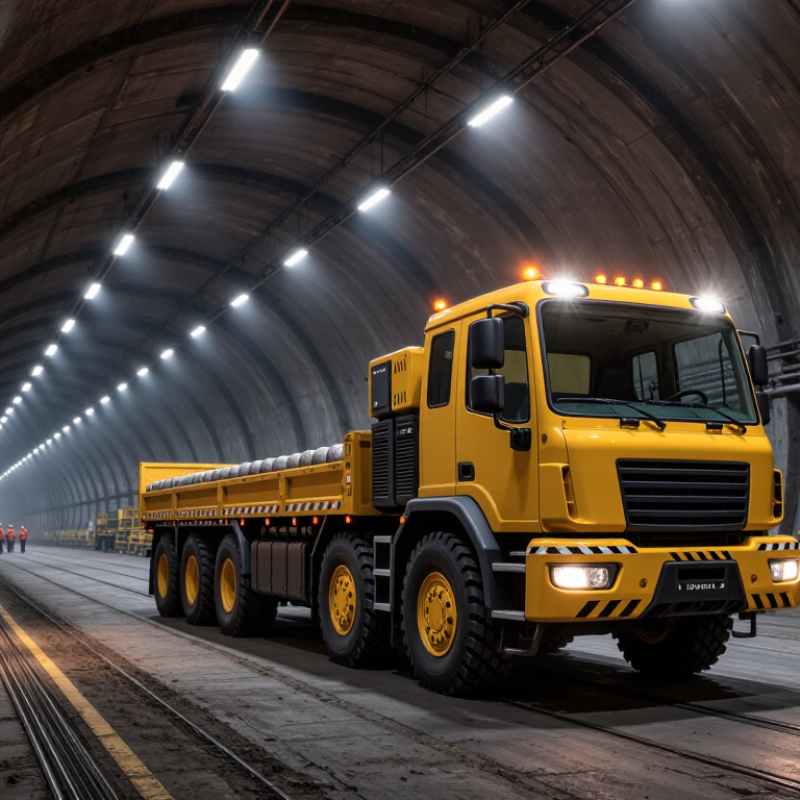
A 10-ton trackless vehicle is a rubber-tired transport machine designed to carry up to 10 metric tons. It travels without rails, using steering, braking, and traction systems for control. Many units operate in underground mines, tunnels, construction sites, and large industrial yards. They move ore, rock, equipment, or supplies through changing routes.
The 10-ton figure usually describes the rated payload, not the vehicle’s total weight. A loaded unit may weigh considerably more. This difference affects braking distance, tire pressure, ramp performance, and ground stability. Experienced operators check the load center carefully. An uneven load can reduce steering control, especially on wet or sloped surfaces.
Typical features include a reinforced frame, high ground clearance, compact turning geometry, and protected driveline components. Diesel power remains useful where charging access is limited, while battery systems can reduce local exhaust emissions. Ventilation requirements still matter in enclosed areas. So does maintenance access. A difficult-to-reach filter wastes time every shift.
In real projects, capacity alone does not prove suitability. Tunnel width, ramp angle, floor strength, visibility, and service support may matter more. The “10-ton” label can also hide practical limits.
Payload may fall on steep grades or rough ground. That detail deserves closer testing before purchase. An inspection drive with the intended load often reveals problems that a specification sheet misses.
How 10-Ton Trackless Vehicles Work
A 10-ton trackless vehicle moves heavy loads without rails, using electric drive motors, steerable wheels, and onboard controls. Its frame carries a battery pack, motor controllers, sensors, and hydraulic or electromechanical lifting equipment. The payload sits low, spreading weight across reinforced platforms. This reduces tipping risk on smooth industrial floors.
Operators usually select a route through a handheld controller, control cabinet, or autonomous navigation system. Cameras, laser scanners, and proximity sensors detect people, walls, and obstacles.
ISO 3691-4:2023 emphasizes speed control, emergency stopping, and safe separation for driverless industrial trucks. The IFR World Robotics 2024 report recorded nearly 205,000 professional service robots sold in 2023. That growth reflects stronger demand for automated material movement, though it does not guarantee safe deployment.
Battery capacity determines working time, while motor torque determines starting performance under load. Charging systems may use opportunity charging during breaks or longer overnight cycles. The IEA Global EV Outlook 2024 reported over 14 million electric car sales in 2023, showing how battery production is scaling across industries. However, heavy vehicles face different problems. Uneven floors, sharp turns, wet surfaces, and poorly balanced loads can quickly reduce range and stability. Real factories are less tidy than diagrams. I would not trust a stated operating range without testing the vehicle on the actual route, with the real load, gradients, and stopping frequency.
2026 Ranking of the Top 10-Ton Trackless Vehicle Manufacturers
The 2026 ranking of the top 10-ton trackless vehicle manufacturers focuses on measurable performance, not advertising claims. Suppliers are assessed through payload stability, steering precision, battery endurance, safety controls, service coverage, and delivery experience. This approach reflects ISO 3691-4 principles for driverless industrial vehicles and supports more reliable factory evaluations.
The International Federation of Robotics reported 541,302 industrial robots installed worldwide in 2023. That figure shows how quickly manufacturers are adopting automated material movement. However, a 10-ton trackless vehicle faces different demands. It must cross uneven concrete, stop beside a loading bay, and turn within narrow production lanes. The strongest ranked manufacturers provide reinforced chassis designs, load sensors, obstacle detection, and practical charging systems. Battery range matters.
Not everything is perfect.
The ranking also considers weaknesses that brochures often hide. Some vehicles lose efficiency under maximum payloads. Others require wider turning spaces than factory drawings suggest. Industry research from Interact Analysis identifies mobile robotics as a growing automation segment, but market forecasts vary by region and vehicle definition. That uncertainty deserves attention. Buyers should request factory trial data, braking-distance records, maintenance intervals, and performance results under a full 10-ton load. A low purchase price may become expensive when tires, batteries, software, or operator training are overlooked. The top ten should therefore represent dependable engineering and long-term operating value, rather than simple sales volume.
2026 Top 10t Trackless Vehicle Manufacturers? - 2026 Ranking of the Top 10-Ton Trackless Vehicle Manufacturers
Comparative ranking based on publicly documented product capabilities, safety features, customization range, service coverage, and industrial application suitability. Manufacturer identities are intentionally omitted.
| Rank | Rated Load
(t) | Drive Configuration | Power Options | Maximum Speed
(km/h) | Typical Gradeability | Steering Mode | Safety System | Typical Applications | Overall Score
(100) |
| 1 | 10 | Four-wheel drive | Battery / diesel | 0–25 | Up to 8% | Steering axle or differential steering | Emergency stop, obstacle sensing, warning beacon | Steel coils, molds, machinery, warehouse transfer | 94 |
| 2 | 10 | Independent dual-drive | Lithium-ion / lead-acid | 0–20 | Up to 6% | Electronic differential steering | Laser scanner, anti-collision sensors, horn | Factory logistics, assembly lines, storage yards | 92 |
| 3 | 10 | Four-wheel drive | Battery electric | 0–18 | Up to 5% | Ackermann steering | Bumper switches, audible alarm, flashing light | Indoor material handling, dies, pallets, tooling | 90 |
| 4 | 10 | Central-drive platform | Lithium-ion | 0–15 | Up to 5% | 360-degree differential steering | Safety laser scanner, speed zoning, E-stop | Automated production cells and intralogistics | 88 |
| 5 | 10 | Six-wheel articulated drive | Battery / hybrid | 0–16 | Up to 7% | Articulated steering | Load monitoring, reverse alarm, emergency stop | Outdoor yards, foundries, heavy fabrication | 86 |
| 6 | 10 | Two-wheel drive with caster support | Lead-acid / lithium-ion | 0–12 | Up to 4% | Differential steering | Mechanical bumper, horn, flashing beacon | Indoor transfer, pallet movement, general workshops | 84 |
| 7 | 10 | Four-wheel steerable chassis | Battery electric | 0–14 | Up to 5% | Front-wheel or four-wheel steering | Proximity sensors, E-stop, status display | Long-load handling and indoor logistics | 82 |
| 8 | 10 | Modular platform chassis | Battery electric | 0–12 | Up to 4% | Remote-controlled differential steering | Remote stop, warning lamp, overload protection | Custom fixtures, assembly plants, maintenance areas | 80 |
| 9 | 10 | Heavy-duty fixed-axle drive | Diesel / battery | 0–10 | Up to 8% | Mechanical steering | Reverse alarm, beacon, hydraulic overload valve | Outdoor yards, construction components, heavy equipment | 78 |
| 10 | 10 | Trailer-style trackless chassis | Battery electric | 0–8 | Up to 3% | Towable steering assembly | Manual emergency stop, horn, reflector system | Short-distance plant transport and low-speed handling | 75 |
Evaluation criteria: rated payload capability, drivetrain flexibility, operating speed, gradeability, steering precision, safety equipment, application suitability, energy options, and customization potential.
Applications and Selection Considerations
A 10-ton trackless vehicle can move heavy loads without fixed rails, making it useful in factories, shipyards, power facilities, construction zones, and warehouse expansion projects. It suits routes that change often. It also works where installing rails would interrupt production or consume valuable floor space.
Application conditions should guide the purchase. Measure the load’s length, center of gravity, and lifting points, not only its total weight. Check floor strength, slope, turning radius, doorway width, and surface debris. In practical site assessments, uneven floors often create greater risks than maximum load limits. Battery vehicles can reduce indoor emissions, while other power systems may support longer outdoor shifts. Weather matters too.
Control accuracy is essential near columns, workers, and stored materials. Ask for documented braking performance, emergency controls, obstacle detection, and load stability testing. Review maintenance access, spare-part availability, operator training, and software support before signing a contract. A vehicle that looks powerful may still waste time if charging takes too long or steering feels slow.
Test it with the real load.
A short trial should include acceleration, stopping, reverse travel, tight turns, and repeated loading cycles. Record energy use and operator feedback. Do not rely on a showroom demonstration. I have seen specifications appear convincing until dust, narrow passages, and poor floor joints exposed weaknesses. A perfect selection rarely exists; careful buyers should identify which compromise their site can safely accept.
2026 Top 10 t Trackless Vehicle Manufacturers? Applications and Selection Considerations
Typical payload requirements for major industrial applications served by 10-ton trackless transfer vehicles. Actual vehicle selection should consider floor conditions, travel distance, duty cycle, load geometry, steering method, and charging requirements.
Selection guidance: Applications regularly operating above 8 tons should use a vehicle with sufficient safety margin rather than running at maximum rated capacity. Coil and die handling typically require precise positioning, while shipyard and structural-steel work places greater emphasis on traction, ground clearance, and long-distance battery endurance.