China Top Black UHMW Plastic Sheet Manufacturer?

Choosing a reliable China manufacturer for Black Uhmw Plastic requires more than comparing prices and surface appearance. Buyers must examine material grade, compression molding methods, dimensional control, and practical service experience. A sheet may look smooth under warehouse lighting, yet warp after cutting or wear quickly under repeated impact.

Dr. Steven M. Kurtz, a recognized UHMWPE researcher and author, has emphasized, “The performance of UHMWPE depends strongly on its molecular weight and processing history.” This principle matters when evaluating Black Uhmw Plastic. Carbon black can improve light resistance and create a consistent dark finish, but it cannot correct poor resin quality or unstable production. Manufacturing evidence matters more than attractive catalog language.

A dependable Chinese supplier should provide technical data, tolerance ranges, sample pieces, and traceable quality records. Ask how the sheets are pressed, cooled, inspected, and packed. Check thickness across several points, especially near the edges. A 10 mm sheet that varies noticeably may create problems during machining or assembly. Real factory photos help, but they are not enough. An on-site audit or independent inspection is better.

The best manufacturer is not always the cheapest. This sounds obvious, but purchasing teams still overlook it. Delivery consistency, communication, and technical support can protect a project from costly rework. Some specifications remain unclear until testing begins. That is where a careful supplier should listen, revise, and document changes. This guide compares leading China-based manufacturers through material performance, production capability, customization, certifications, and customer reliability. Mistakes are possible. Transparent evidence makes them easier to identify before production starts.

China Top Black UHMW Plastic Sheet Manufacturer?

What Is Black UHMW Plastic Sheet?

What Is Black UHMW Plastic Sheet?

Black UHMW plastic sheet is made from ultra-high molecular weight polyethylene. Its long molecular chains create strong resistance to abrasion, impact, and sliding wear. The black color usually comes from carbon-based pigment added during production. Some grades also include additives for improved outdoor stability, but this should be verified with the technical data sheet.

In practical use, the sheet feels smooth and wax-like. It can reduce noise when used as a chute liner, guide rail, wear strip, or hopper lining. Moisture does not easily penetrate its surface. Many workshops machine it with standard carbide tools, although sharp tooling improves the finish. Proper cutting also reduces heat buildup and edge distortion.

UHMW plastic is not a perfect replacement for metal. It can expand with temperature changes and may creep under constant heavy loads. It also has limited resistance to high heat. These points are easy to overlook. When selecting a sheet, check thickness tolerance, flatness, impact performance, operating temperature, and material certification. A reliable manufacturer should provide inspection records and clear testing methods. Small differences in formulation can affect service life. That deserves careful review.

How Black UHMW Plastic Sheets Are Manufactured in China

How Black UHMW Plastic Sheets Are Manufactured in China

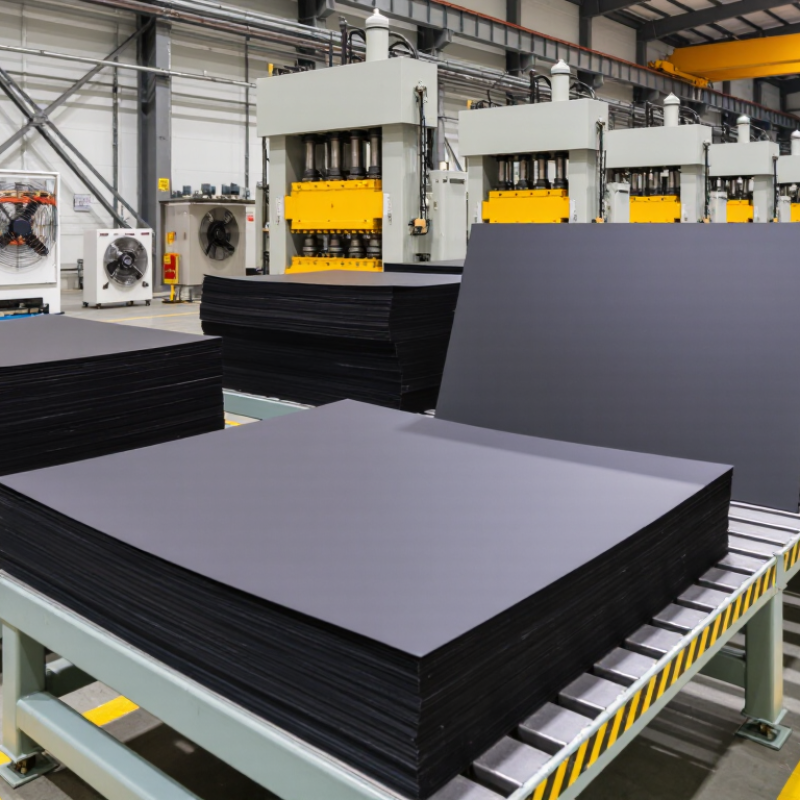
Manufacturing black UHMW plastic sheets in China begins with carefully selected ultra-high molecular weight polyethylene resin. Carbon black is blended into the resin to create a deep, consistent color and improve resistance to ultraviolet exposure. The mixture passes through controlled heating and high-shear mixing equipment. Moisture and contamination must remain extremely low. Small errors can affect the final surface.

Many factories use compression molding or ram extrusion for sheet production. Heated material is formed under pressure, then cooled gradually to reduce internal stress. After cooling, workers trim the edges and machine the sheet to the required thickness. Experienced technicians check flatness, density, surface finish, and dimensional tolerance. Wear testing and impact testing may also be performed, depending on the intended application. Results should be recorded for traceability. The process is reliable, but not perfect; warping can still appear when cooling is uneven.

Tips: Ask for resin details, thickness tolerance, and inspection records before ordering. Request a sample sheet and examine its color, edges, and surface smoothness. Confirm whether the supplier can provide batch traceability and test data. Clear specifications prevent avoidable disputes. A practical review matters.

Key Properties and Performance Standards

China Top Black UHMW Plastic Sheet Manufacturer? Key Properties and Performance Standards

Black UHMW plastic sheet is valued for low friction, impact resistance, and dependable wear performance. ASTM D4020 identifies UHMW polyethylene materials with densities commonly near 0.93–0.95 g/cm³. That light structure helps reduce equipment weight without sacrificing toughness.

Independent test reports using ASTM D638 often show tensile strengths around 20–40 MPa, depending on grade, thickness, and processing. Friction coefficients may range from 0.05 to 0.15 under dry sliding conditions. Impressive, but not universal. Surface finish, load, temperature, and counterface can change results sharply. ASTM D256 impact testing also matters when sheets face sudden contact or repeated shock.

Black pigmentation can improve light resistance when suitable carbon black content is evenly dispersed. However, color alone does not prove outdoor durability. A reliable manufacturer should provide batch-specific inspection records, thickness tolerances, density results, and test conditions. ISO 178 flexural testing and ISO 1133 melt-flow data can support process consistency, although these values do not predict every field application. Some published datasets use ideal laboratory conditions. Real conveyors are dirtier, hotter, and less forgiving. Ask for traceable reports before selecting a sheet for liners, guides, or high-wear components.

Key Properties and Performance Standards of Black UHMW-PE Sheet

The chart uses a representative engineering value as an index of 100 for each property. Typical UHMW-PE sheet values include tensile strength of approximately 20–40 MPa, elongation at break of 300–600%, a coefficient of friction of about 0.08–0.20, and water absorption below 0.01%. Actual performance depends on molecular weight, processing method, thickness, temperature, and test standard.

How to Evaluate a Top Black UHMW Sheet Manufacturer

How to Evaluate a Top Black UHMW Sheet Manufacturer

A top black UHMW sheet manufacturer should prove material consistency, not only offer a polished website. Request the resin grade, molecular-weight range, density, thickness tolerance, and black pigment details. ASTM D4020 covers UHMW polyethylene molding and extrusion materials. A serious supplier should provide test methods and batch records aligned with this standard. Ask for samples from separate production lots. One sample can hide variation.

Check wear performance under your actual conditions. Sliding speed, load, temperature, and mating metal can change results significantly. ASTM G65 abrasion testing may help compare wear resistance, but it does not reproduce every conveyor or chute application. The Plastics Industry Association reported that U.S. plastics machinery shipments reached about 31,000 units in 2023, showing a large and competitive processing sector. Capacity alone proves little. Inspect extrusion lines, cooling control, trimming accuracy, and storage practices.

Traceability matters. Each sheet should carry a lot number, production date, thickness, and inspection result. Request tensile, impact, and density data from an independent laboratory when the application is critical. ISO 9001 certification supports process control, yet certification cannot replace physical testing. Be cautious with impressive wear claims. I would compare three lots, not three brochures. Some suppliers may provide excellent sheets, but their documentation remains incomplete. That weakness deserves discussion before a purchase contract.

Applications, Customization, and Quality Assurance

A top black UHMW plastic sheet manufacturer should understand where the material works, not merely how it looks. UHMW polyethylene offers low friction, strong abrasion resistance, and dependable impact protection. It suits conveyor wear strips, hopper liners, guide rails, truck bed liners, and marine fender components. Black sheets also help conceal surface marks in demanding industrial areas. However, color alone does not prove quality.

Customization begins with the working conditions. Engineers should review load, sliding speed, temperature, moisture, chemical contact, and installation space. Sheets can be cut, drilled, beveled, or machined to fit existing equipment. Thickness and surface finish may also require adjustment. A practical manufacturer checks drawings before production and confirms tolerances clearly. Small errors matter. A hole placed two millimeters incorrectly can delay installation.

Quality assurance should include incoming resin checks, production records, dimensional inspection, and visual examination. Samples can be tested for thickness, density, impact behavior, and abrasion performance when the application demands it. Traceable batch information supports reliable maintenance decisions. Experienced suppliers also explain material limits instead of promising universal performance. UHMW plastic can deform under sustained heat or heavy point loading. That weakness deserves attention. Real project feedback should influence future designs, because even a carefully specified sheet may perform differently in dust, cold, or continuous friction.

China Top Black UHMW Plastic Sheet Manufacturer? - Applications, Customization, and Quality Assurance
Category Data Dimension Typical Technical Reference Applications, Customization, or Quality Considerations
Material Profile Material Type Ultra-high-molecular-weight polyethylene, commonly abbreviated as UHMW-PE or UHMWPE. Used where low friction, high abrasion resistance, impact resistance, and non-stick performance are required.
Material Profile Color Black coloration is generally produced with carbon black or another approved black pigment system. Black sheets are often selected for light shielding, visual masking, outdoor identification, and improved resistance to ultraviolet exposure when an appropriate UV-stabilized formulation is used.
Material Profile Density Approximately 0.93–0.95 g/cm³ is a common reference range for UHMWPE, depending on formulation and test method. The density should be verified using a documented laboratory method such as ASTM D792 or ISO 1183.
Material Profile Water Absorption Very low water absorption compared with many engineering plastics. Suitable for wet environments, marine components, food-processing equipment, tank linings, and applications requiring dimensional stability in contact with water.
Performance Abrasion Resistance High abrasion resistance is a primary characteristic of UHMWPE; actual performance depends on load, counter-surface, speed, temperature, and grade. Common uses include chute liners, hopper liners, conveyor wear strips, guide rails, scraper blades, and bulk-material handling components.
Performance Coefficient of Friction Low sliding friction is typical, but the measured value varies with mating material, surface finish, pressure, speed, lubrication, and test conditions. Beneficial for bearings, sliding pads, wear strips, chain guides, rollers, and material-flow surfaces.
Performance Impact Resistance UHMWPE is recognized for high impact toughness and resistance to repeated impact loading. Used for impact liners, protective panels, fender components, machine guards, and material-transfer areas.
Performance Temperature Range A commonly referenced continuous service range is approximately −100°C to +80°C, subject to grade, load, duration, and design conditions. Final designs should consider creep, thermal expansion, pressure, and the difference between short-term peak temperature and continuous operating temperature.
Customization Sheet Thickness Thickness is typically specified according to the mechanical load, wear allowance, mounting method, and required service life. Custom thickness may be requested for liners, gaskets, wear pads, tank protection, and fabricated assemblies. Availability depends on production equipment and order requirements.
Customization Sheet Dimensions Length and width should be defined according to equipment geometry, transport limitations, installation access, and cutting yield. Large-format sheets can reduce the number of joints, while smaller cut panels may simplify handling and installation.
Customization Surface Finish Available finishes may include standard pressed, machined, textured, or specially prepared surfaces, depending on the manufacturing route. Surface requirements should state roughness, texture, flatness, and whether the sheet will be used for sliding, lining, bonding, or printing.
Customization CNC and Secondary Processing UHMWPE can generally be saw-cut, drilled, routed, milled, turned, and machined with suitable tooling and process controls. Custom parts may include holes, slots, countersinks, grooves, chamfers, radii, mounting patterns, and pre-cut installation kits.
Customization Dimensional Tolerances Tolerance requirements should be agreed according to sheet thickness, size, machining method, thermal expansion, and intended assembly fit. Critical dimensions should be identified separately from general dimensions, with inspection tools and acceptance limits defined before production.
Applications Bulk Material Handling Liner and wear components for hoppers, chutes, bins, silos, conveyor systems, and transfer points. The low-friction surface helps reduce material hang-up and bridging; thickness and fastening design must account for impact and abrasion.
Applications Mining and Quarrying Wear liners, impact pads, chute liners, screening components, and protective machine parts. Selection should consider mineral particle size, impact energy, abrasion mode, operating temperature, and replacement accessibility.
Applications Food and Packaging Equipment Guide rails, wear strips, star-wheel components, conveyor parts, and sliding elements, subject to applicable regulatory requirements. For direct food contact, the specific formulation, additives, cleanliness controls, and regulatory documentation must be verified for the destination market.
Applications Marine and Water Systems Fender pads, dock components, wear pads, bearing surfaces, and low-friction sliding parts. Low water absorption and corrosion resistance are advantageous; fasteners and joints should be designed for marine exposure and thermal movement.
Applications Chemical and Industrial Equipment Tank liners, pump components, gaskets, scrapers, wear pads, and protective barriers. Chemical compatibility must be checked against concentration, temperature, exposure time, stress level, and the complete service environment.
Quality Assurance Incoming Raw Material Control Review of raw-material identification, certificate documentation, formulation requirements, pigment or carbon-black system, and batch traceability. Traceability should connect the finished sheet to the production batch and inspection records without relying on brand-specific claims.
Quality Assurance Visual and Dimensional Inspection Checks may include color uniformity, surface defects, edge condition, length, width, thickness, flatness, and visible contamination. Inspection frequency and sampling plans should be documented, especially for custom-cut parts and critical installation dimensions.
Quality Assurance Density Testing ASTM D792 or ISO 1183 may be used as reference methods for polymer density measurement. Density results can support material consistency checks but should not replace application-specific mechanical and chemical testing.
Quality Assurance Tensile Testing ASTM D638 or ISO 527 may be used to evaluate tensile strength, elongation, and related tensile properties. Test results should identify specimen orientation, conditioning, test speed, temperature, and the applicable material grade.
Quality Assurance Hardness Testing Shore hardness may be measured with a suitable method such as ASTM D2240, when appropriate for the material and product form. Hardness is useful for comparative quality control but does not independently predict abrasion life or load-bearing performance.
Quality Assurance Abrasion and Wear Validation Wear testing should use a defined laboratory method and application-representative load, speed, counterface, and abrasive medium. Because wear behavior is highly application-dependent, comparative testing under real service conditions is recommended for critical components.
Quality Assurance Certificate and Documentation A complete quality package may include product specification, batch number, inspection report, dimensional results, test data, and packing records. Documentation should state actual measured values, test methods, lot identification, inspection date, and any agreed acceptance criteria.
Purchasing Guide Information to Include in an RFQ Material type, black-color requirement, dimensions, thickness, tolerance, quantity, application, operating temperature, load, wear conditions, machining details, and required standards. Providing complete technical information improves quotation accuracy and reduces the risk of selecting an unsuitable sheet grade or design.
Technical values shown are typical industry reference information rather than guaranteed product specifications. Final properties, tolerances, certifications, and service limits should be confirmed against the selected material grade, production batch, test method, and application conditions.
Translate