
How to Choose the Best Drill Accessories in 2026?
Choosing the best Drill Accessories in 2026 requires more than matching a bit to a drill chuck. It means understanding materials, working conditions, safety limits, and long-term value. A masonry bit that performs well in concrete may chip quickly against porcelain tile. A wood spade bit may overheat when forced through laminated panels. Small differences matter.
Tom Silva, veteran contractor and longtime This Old House expert, often shares a practical rule: “Use the right tool for the job.” That advice remains highly relevant. The correct accessory should fit the drill, suit the material, and match the task’s speed and pressure requirements. Check shank compatibility, coating quality, cutting geometry, and manufacturer testing. For cordless drills, battery efficiency also matters. A poorly balanced accessory can drain power and strain the user’s wrist.
Real workshop experience reveals an uncomfortable truth. The most expensive accessory is not always the best choice. Cheap sets can also create hidden costs through dull edges, damaged surfaces, and repeated replacements. I have found that performance claims need practical checking. Look for clear specifications, impact ratings, size accuracy, warranty terms, and credible user feedback. Do not trust impressive packaging alone.
This guide examines drill bits, driver heads, hole saws, sanding attachments, and specialty options for different projects. It also considers storage, cleaning, and safe operating habits. Some recommendations may not suit every user. That is worth admitting. The best choice depends on your materials, workload, budget, and patience.
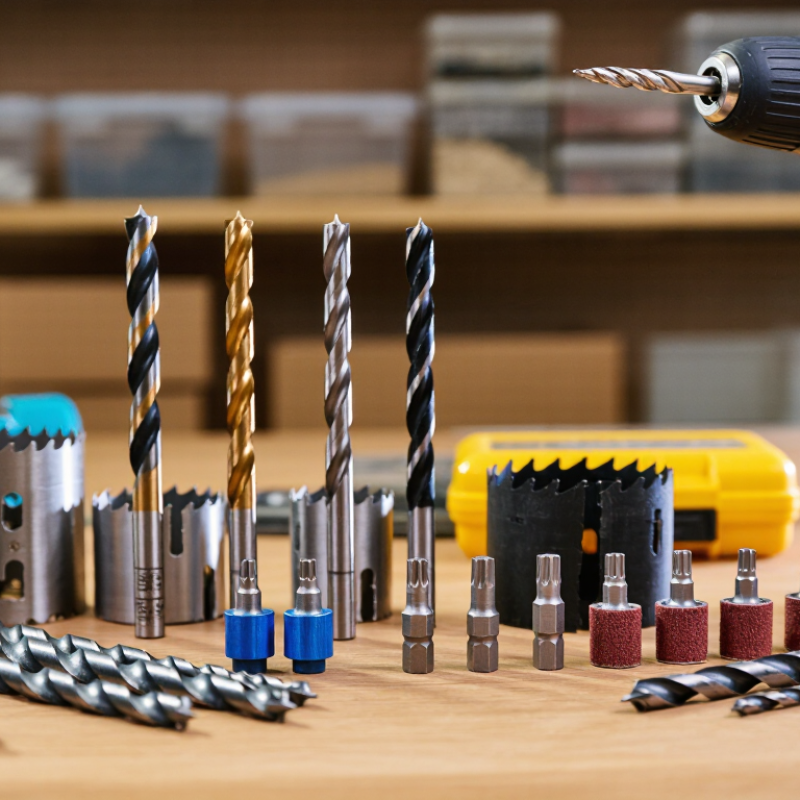
Identify Your Drill Type, Power, and Intended Applications
Choosing the best drill accessories starts with the drill itself. Check whether it is a compact driver, hammer drill, rotary hammer, or bench-mounted model. Each type accepts different accessories and produces different impact forces. A standard twist bit may work in wood, but masonry demands a hammer-rated bit and suitable carbide geometry. Check the chuck size and fitting system before buying.
Power matters more than many shoppers expect. Record voltage, torque, speed ranges, and battery capacity. Grand View Research reported that the global power tools market was valued at over USD 36 billion in 2023, showing how widely cordless equipment is used. Yet battery voltage alone can mislead. A high-voltage drill with poor speed control may damage small screws or split soft timber. Test the trigger gently. Feel the resistance.
Application should guide the accessory choice. For clean holes in plywood, use brad-point bits and moderate speed. For metal, select cobalt or other heat-resistant bits, then apply cutting fluid. For concrete, use masonry accessories rated for hammer action. The International Energy Agency’s Global EV Outlook 2024 notes continuing growth in lithium-ion battery demand, but battery performance still falls in cold workshops. I have made that mistake myself. A “universal” accessory is convenient, not always reliable. Check the manufacturer’s stated material limits, inspect worn edges, and replace accessories that wobble. Small details matter.
How to Choose the Best Drill Accessories in 2026? — Identify Your Drill Type, Power, and Intended Applications
| Drill Type | Typical Power or Capacity | Recommended Applications | Best Accessory Category | Useful Accessory Features | Common Material Compatibility | Selection Guidance |
|---|---|---|---|---|---|---|
| Cordless Drill/Driver | 12–18 V common Variable speed Adjustable clutch | General fastening, pilot holes, furniture assembly, light construction, and routine maintenance. | Twist drill bits Screwdriver bits Nut drivers Hole saws | Hex-shank bits for quick changes; clutch-compatible driving accessories; bit sets covering multiple sizes. | Wood, plastics, thin metal, and masonry with suitable bits and controlled speed. | Match the accessory shank and size to the chuck capacity. Use lower speed for larger bits. |
| Corded Drill | Approx. 500–1,000 W common Continuous mains power Often higher sustained runtime | Extended drilling, workshop tasks, large-hole drilling, and jobs requiring continuous operation. | High-speed steel bits Hole saws Wire wheels Sanding attachments | Heat-resistant cutting edges; rated mandrels; side handles for improved control during high-load work. | Wood, metal, plastics, and masonry when the drill has an appropriate operating mode. | Check the drill’s rated speed and maximum bit diameter before using large accessories. |
| Hammer Drill | Typically 500–900 W corded Or 12–24 V cordless Rotary and hammer modes | Drilling anchor holes in brick, block, concrete, and general-purpose drilling when hammer action is switched off. | Carbide-tipped masonry bits Multi-material bits Concrete drill bits | Reinforced carbide tips; round or hex shanks; diameter matched to the anchor or fastener. | Brick, block, concrete, stone, wood, and metal depending on mode and bit type. | Use hammer-rated masonry bits only when impact mode is engaged. Do not use ordinary bits in hammer mode. |
| Rotary Hammer | Approx. 2–10 J impact energy Typically 18–36 V cordless or corded Dedicated hammer mechanism | Heavy-duty concrete drilling, anchor installation, light chiseling, and removal of masonry materials. | SDS-type masonry bits Chisels Core bits Dust-extraction accessories | Impact-rated shank system; reinforced carbide heads; dust-control connection; correct bit length for hole depth. | Concrete, reinforced concrete, brick, block, and stone. | Use only accessories compatible with the tool’s chuck system and impact rating. Avoid standard twist bits. |
| Impact Driver | 12–20 V common High torque Quick-change hex chuck | Driving long screws, structural fasteners, lag screws, self-drilling screws, and repetitive fastening. | Impact-rated screwdriver bits Impact nut drivers Socket adapters Right-angle adapters | Shock-resistant torsion zones; 1/4-inch hex shanks; impact-rated sockets and adapters. | Wood, metal, composite materials, and masonry anchors when the accessory is specifically rated. | Use impact-rated accessories only. Standard brittle bits may fracture under repeated impacts. |
| Drill Press | Stable spindle alignment Variable or selectable speed Table-supported workpiece | Accurate, repeatable holes, metal fabrication, woodworking, countersinking, and batch production. | Twist drill bits Forstner bits Countersinks Step drill bits | Precision-ground cutting edges; suitable arbor; workholding clamps; speed matched to material and diameter. | Wood, metal, plastics, laminates, and composites. | Secure the workpiece before drilling. Larger diameters generally require lower spindle speeds. |
| Right-Angle Drill | Typically 12–20 V cordless Compact head design Moderate torque | Drilling and fastening in narrow cavities, between studs, inside cabinets, and under flooring. | Short drill bits Right-angle bit holders Compact hole saws Flexible shafts | Short overall length; locking bit holder; torque-rated right-angle attachments; compact accessory profile. | Wood, plastics, thin metal, and light-duty fastening materials. | Confirm that the attachment’s torque and speed ratings match the drill and the task. |
| Rotary Tool | Approx. 5,000–35,000 rpm common Low torque Small accessory diameter | Detail sanding, engraving, polishing, trimming, deburring, and precision cutting. | Small abrasive wheels Sanding drums Grinding stones Polishing points | Small collet-compatible shanks; balanced accessories; variable-speed control; appropriate guard or eye protection. | Wood, plastic, soft metals, ceramics, and composites depending on the accessory. | Use accessories within the tool’s maximum rated speed. Do not force the tool into heavy drilling work. |
| Magnetic Drill | Typically 900–2,000 W corded Magnetic base Designed for steel work | Large-diameter holes in structural steel, fabrication, installation, and maintenance work. | Annular cutters HSS core drills Pilot pins Cutting-fluid systems | Magnetic-base compatibility; coolant delivery; cutter diameter matched to the machine; secure pilot pin. | Low-carbon and structural steel; use only manufacturer-rated materials and cutting conditions. | Ensure the magnetic base is fully engaged on a clean, sufficiently thick ferrous surface. |
| Specialty Glass or Tile Drill | Low-speed operation preferred Hammer mode disabled Controlled pressure | Installing fixtures, drilling ceramic tile, glass, mirrors, porcelain, and other brittle surfaces. | Spear-point carbide bits Diamond-grit hole saws Tile drill guides | Diamond or carbide cutting surface; water cooling where permitted; guide templates to reduce wandering. | Ceramic tile, porcelain, glass, stone tile, and similar brittle materials. | Start slowly, use light pressure, and keep the cutting area cool when the accessory instructions require it. |