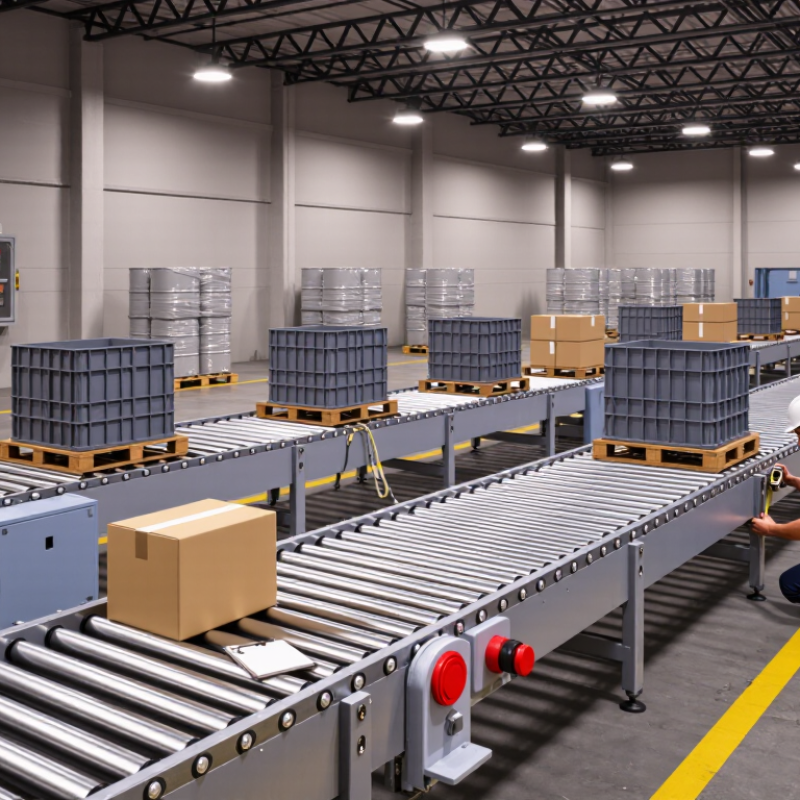
Choosing the right Roller Conveyor begins with a clear picture of the work, not with a rushed equipment order. What will it carry? Cartons, totes, drums, or uneven packages? Each product behaves differently on steel rollers. A small box may stop between rollers. A heavy drum may demand stronger frames and closer spacing. The details matter.
Material-handling engineer David J. Williams explains, “The right conveyor begins with the product, not the machine.” This principle remains practical on the warehouse floor. Measure package weight, length, width, bottom condition, and travel speed. Check whether loads move freely or require controlled accumulation. Powered rollers may suit long routes and steady throughput. Gravity rollers can work well for short, manual handling areas. They are simpler. But “simple” does not always mean suitable.
Think about the environment, too. Dust, moisture, temperature, noise, and cleaning routines affect performance. A poorly selected bearing may fail beside a washdown station. A narrow frame may create awkward loading and safety risks. I have seen specifications focus heavily on speed while ignoring package stability. That is an easy mistake. Real conditions often challenge laboratory assumptions.
This guide will compare roller sizes, materials, drive options, load capacities, and maintenance needs. It will also question common shortcuts. The cheapest Roller Conveyor may cost more through jams, repairs, and downtime. A reliable choice balances present demand with reasonable future growth. Leave room for doubt. Recheck the measurements before approval. Good conveyor selection is not dramatic, but it is precise.
How to Choose the Right Roller Conveyor?
Choosing a roller conveyor starts with three measurable facts: load, product size, and throughput. Record the maximum load in kilograms, not the average. A box weighing 18 kg may require a 25 kg design allowance. Include sudden placement and uneven weight distribution. These details affect roller diameter, frame strength, and motor capacity.
Measure product length, width, and height in millimetres. The smallest product must rest on at least three rollers. For example, a 240 mm carton may need rollers spaced below 80 mm apart. Check the product base, too. Flexible packaging can sag between rollers. My early estimate focused only on weight, and the cartons still moved poorly. That was a useful mistake.
Tips: Write the largest and smallest product dimensions beside the conveyor layout. Calculate throughput in units per hour, then allow for gaps, stops, and operator handling. If the target is 600 units per hour, the conveyor may need a higher rated capacity during busy periods. Test one sample carton at the real speed. Watch for sliding, bouncing, and damaged corners. Measure actual output for ten minutes. The result may challenge the original specification. Conditions change. Dust, temperature, and product surfaces can also alter performance. A short trial often reveals more than a neat spreadsheet.
How to Choose the Right Roller Conveyor?
For typical speeds of 0.1–0.5 m/s, gravity and powered rollers can both work well. Gravity rollers suit cartons moving down a slight slope or handled by operators. They need fewer components, but product flow can become uneven. Powered rollers provide steady movement across level sections. They are better for accumulation, scanning, and controlled spacing. The choice depends on load weight, carton surface, line length, and stop frequency.
MHI’s 2024 Annual Industry Report found that 83% of respondents consider supply chain innovation important. That figure supports careful automation decisions, not automatic over-automation. For a 0.1 m/s line, gravity may offer enough control. Near 0.5 m/s, powered rollers often reduce hesitation at transfers. Roller pitch should support the smallest carton with at least three rollers underneath. CEMA engineering guidance also stresses checking load capacity, speed, and operating conditions together. A calculation can still miss real friction. Dust, damaged cartons, and uneven floors change performance.
Tips: Test the heaviest and smallest packages first. Measure actual speed, not the motor setting. Keep a manual section for inspection access. Ask whether accumulation is truly needed. It often is not. I would also leave adjustment room in the design. A conveyor that works perfectly on day one may struggle after packaging changes. Safety guarding, emergency stops, and operator access require site-specific review.
Choose gravity or powered rollers for typical conveying speeds of 0.1–0.5 m/s. Gravity rollers are suitable for free-flowing loads and simple layouts, while powered rollers provide consistent movement, controlled spacing, and better performance on inclines or automated lines.
Typical guidance: Gravity roller conveyors commonly operate from about 0.1 to 0.3 m/s. Powered roller conveyors can cover approximately 0.1 to 0.5 m/s, depending on load weight, roller pitch, drive method, accumulation requirements, and conveyor layout. Actual design values should be confirmed through load and system calculations.
Roller diameter and pitch should be selected together. The key rule is simple: keep pitch no greater than one-third of the load length. This allows at least three rollers to support a stable load. CEMA’s ANSI/CEMA 401-2019 standard also emphasizes adequate roller support for safe, predictable conveying. For example, a 900 mm carton should use a maximum pitch of 300 mm. A 250 mm pitch may perform better when the carton is flexible or unevenly loaded.
Roller diameter depends on load weight, contact area, and frame capacity. Heavier loads usually need larger rollers because they reduce bending and surface stress. Small packages need closer pitch, even when their total weight is modest. A narrow box can tilt between widely spaced rollers. That detail is often missed.
Measure the load’s travel length, not its width. Then divide that length by three. Round down when choosing the actual pitch. Irregular pallets deserve extra caution. Their underside may bridge gaps poorly. Field conditions are rarely perfect, and a clean calculation can still fail with damaged boards or shifted cartons. A practical inspection should check contact at entry, transfer points, and stopping zones. Refer to ANSI/CEMA 401-2019 and the CEMA Conveyor Equipment Standards for final sizing verification.
A roller conveyor should support every item with at least three rollers at the same time. This rule reduces rocking, tipping, and sudden load transfer. It matters most when cartons have uneven bottoms or flexible packaging.
Measure the item’s length in the conveying direction. Then compare it with the roller pitch, which is the distance between roller centers. For example, a 600-millimeter carton generally needs a pitch of 200 millimeters or less to maintain three-point support. Leave a practical safety margin. Real cartons may shift, bend, or stop between rollers.
Do not judge capacity by total load weight alone. Divide the load across the rollers carrying it, then check each roller, shaft, bearing, and conveyor frame. Weight can concentrate near one corner. A steel container may seem stable, while a soft box can sag between rollers. It may need four or more rollers underneath.
Test the actual product at operating speed. Watch the leading edge as it transfers between sections. Listen for impacts. A spreadsheet may look correct, yet the load can still wobble. That is where the design needs reconsideration. Temperature, moisture, and damaged packaging can also change performance. A conservative pitch and a small capacity reserve usually create a more reliable conveyor.
How to Choose the Right Roller Conveyor?
Frame material should match the environment, load, and cleaning routine. Powder-coated carbon steel suits dry warehouses and moderate loads. Stainless steel performs better near moisture, chemicals, or frequent washdowns. Aluminum reduces weight, but it may flex under concentrated loads. I have seen low-cost frames twist when pallets stop suddenly. That choice looked efficient, but it created alignment problems later.
Controls deserve equal attention. Variable-speed drives help operators match conveyor speed to packing stations. Photoelectric sensors can stop products before collisions occur. Emergency-stop pull cords, fixed guards, and accessible disconnects support safer operation. ANSI/ASSP B20.1 provides recognized conveyor safety guidance. The U.S. Bureau of Labor Statistics reported 2.61 million nonfatal workplace injuries in private industry during 2023. Conveyor safeguards cannot remove every risk, but poor access makes risks harder to control. Keep controls simple. Complexity can confuse during an emergency.
Maintenance requirements often decide the real cost. Choose roller bearings, chains, and motors that technicians can inspect without removing nearby equipment. Provide cleaning access beneath transfer points. Track lubrication intervals and inspect unusual noise, heat, and vibration. MHI’s 2024 Annual Industry Report found that 88% of respondents were increasing investment in supply-chain technology and innovation. Automation is growing, yet maintenance planning sometimes lags behind. That is worth questioning. A conveyor with advanced sensors still fails when spare rollers, manuals, or trained workers are unavailable. Reliable selection connects materials, controls, safety, and daily service conditions.
A practical comparison of common roller conveyor configurations for unit loads, cartons, totes, and pallets.
| Comparison Dimension | Galvanized Carbon Steel Gravity Roller Conveyor | Painted Carbon Steel Powered Roller Conveyor | Stainless Steel Powered Roller Conveyor | Aluminum Gravity Roller Conveyor |
|---|---|---|---|---|
| Typical Best Use | Cartons, totes, and pallets Warehouses, shipping areas, and dry distribution zones. | Controlled movement and accumulation Packaging lines, assembly areas, and distribution systems. | Washdown or corrosive environments Food-related, pharmaceutical, chemical, and humid applications when the complete system is specified accordingly. | Light-duty, portable conveying Temporary lines, loading areas, workstations, and manual transfer points. |
| Frame Material | Carbon steel with a zinc coating for improved resistance to normal indoor humidity and abrasion. | Carbon steel with a protective industrial paint or powder-coat finish. | Stainless steel frame and compatible stainless components; the selected grade should match the cleaning chemicals and environment. | Extruded or formed aluminum frame, usually selected for low weight and easy repositioning. |
| Relative Corrosion Resistance | ★★★☆☆ Suitable for dry indoor areas; cut edges, scratches, and standing water can reduce protection. | ★★☆☆☆ Suitable for dry indoor areas; damaged coating can expose carbon steel to corrosion. | ★★★★★ Strong resistance when the alloy, weld finish, fasteners, bearings, and motors are suitable for the environment. | ★★★☆☆ Aluminum resists atmospheric corrosion, but other attached components may not have the same resistance. |
| Typical Load Capability | Medium to high, depending on roller diameter, roller spacing, frame depth, supports, and load distribution. | Medium to high; powered capacity depends on drive type, motor torque, speed, incline, and accumulation requirements. | Light to medium or high, depending on the stainless frame design and drive components selected. | Light to medium; best for evenly distributed cartons, totes, and other loads within the frame and roller rating. |
| Roller Selection | Steel rollers are common; roller spacing should support the load with multiple rollers under the item at all times. | Steel rollers, coated rollers, or motor-driven rollers may be used; the surface should suit the product and required traction. | Stainless, polymer, or hygienic roller designs may be used; avoid incompatible metals and materials that trap contaminants. | Aluminum or lightweight steel rollers are common; verify deflection and bearing capacity for the intended load. |
| Controls | Usually no electrical controls. Product movement depends on manual pushing or conveyor slope. | May include motor starters, variable-frequency drives, photoelectric sensors, zone controllers, timers, logic controllers, and accumulation control. | May include low-voltage zone controls, sensor-based accumulation, variable-speed drives, and washdown-suitable control enclosures. | Usually manual. Powered sections can be added, but the frame and component ratings must be checked as a complete system. |
| Speed Considerations | Speed varies with slope, load weight, roller friction, and operator handling; speed regulation is limited. | Commonly adjustable through drive controls; the correct speed must prevent product instability, jams, and unsafe access. | Adjustable speed is available, but controls, motors, sensors, and wiring must suit moisture and cleaning conditions. | Generally low to moderate manual transfer speed; not intended for uncontrolled high-speed accumulation. |
| Accumulation Capability | Limited. Uncontrolled gravity flow can create product collisions, especially on slopes. | Good when designed with zero-pressure or minimum-pressure accumulation zones, sensors, and suitable controls. | Good when hygienic sensors, sealed components, and suitable accumulation controls are specified. | Limited unless additional powered or braking sections are installed. |
| Safety Features to Specify | Side guides, end stops, controlled slope, pinch-point labels, stable supports, and guards at transfer points. | Emergency-stop devices, fixed guards around chains and sprockets, nip-point protection, side guards, overload protection, and lockout/tagout provisions. | Emergency stops suitable for the washdown area, hygienic guarding, sealed electrical components, protected pinch points, and corrosion-resistant fasteners. | Stable legs, caster brakes where applicable, end stops, side guides, manual-handling controls, and protection from tipping or unintended movement. |
| Operator Access Risk | Lower mechanical complexity, but gravity movement and pinch points remain hazards at transfers, stops, and converging sections. | Higher due to powered rollers, belts, chains, and automated zones; access control and guarding are essential. | Similar powered-equipment risks to carbon-steel systems, plus additional risks if cleaning requires frequent access or wet floors. | Generally lower mechanical risk, but manual handling, unstable loads, and unexpected movement still require controls. |
| Routine Maintenance | Inspect rollers, bearings, frame joints, supports, side guides, and level; remove debris and replace damaged rollers. | Inspect motors, gearboxes, chains or belts, bearings, sensors, guards, emergency stops, and electrical connections. | Inspect seals, welds, fasteners, bearings, sensors, motors, and drainage areas; remove chemical residue after cleaning. | Inspect roller bearings, frame connections, caster brakes, supports, and alignment; check for bent or overloaded sections. |
| Lubrication Requirements | Lubricate serviceable bearings and moving joints according to the component manufacturer's instructions. | Lubricate chains, bearings, and gear components as specified; prevent lubricant from contacting conveyed products where applicable. | Use lubricants compatible with the environment and cleaning process; many sealed components are selected to reduce routine lubrication. | Usually low, but serviceable bearings and joints still require inspection and lubrication when specified. |
| Cleaning Requirements | Dry cleaning or controlled wiping is preferred; avoid prolonged exposure to water and corrosive chemicals. | Use cleaning methods compatible with the coating, motor, sensors, and electrical enclosures; do not direct high-pressure spray at components unless rated for it. | Designed for easier cleaning, but “stainless steel” alone does not make every component suitable for washdown. Verify ingress protection and hygienic design. | Easy to wipe and reposition; protect bearings, fasteners, and dissimilar-metal connections from unsuitable chemicals and trapped moisture. |
| Installation Complexity | Low to moderate; correct leveling, slope, support spacing, and load direction are important. | Moderate to high; requires electrical installation, control integration, sensor alignment, guarding, commissioning, and safety verification. | Moderate to high; includes powered-system integration plus material compatibility and washdown considerations. | Low; sections are relatively easy to move and configure, but stability and alignment must be checked. |
| Relative Initial Cost | $$ Typically economical for simple gravity conveying. | $$$ Higher because of drives, controls, sensors, guarding, and commissioning. | $$$$ Higher material and component costs are common, especially for hygienic or washdown designs. | $$ Cost-effective for light-duty and portable applications, but capacity is usually more limited. |
| Energy Demand | Very low during operation because movement is manual or gravity-driven. | Moderate; energy use varies with motor efficiency, operating hours, conveyor speed, load, and accumulation strategy. | Moderate; similar to powered carbon-steel systems, with additional requirements possible for washdown or environmental protection. | Very low for manual operation; powered additions increase energy demand according to their motor and controls. |
| Key Selection Check | Confirm load weight, load dimensions, roller spacing, slope, braking needs, and safe transfer height. | Confirm throughput, accumulation method, speed range, motor sizing, control architecture, guarding, and emergency-stop coverage. | Confirm cleaning chemicals, temperature, moisture exposure, material grade, enclosure rating, drainage, and hygienic design requirements. | Confirm maximum load, frame deflection, section stability, caster capacity, manual handling limits, and frequency of relocation. |