7 Tips for Buying a Jacquard Guide Board
A Jacquard Guide Board can influence pattern accuracy, fabric consistency, and machine uptime. Choosing one is not just a matter of matching dimensions. A board that fits poorly may cause alignment problems, uneven movement, or avoidable maintenance. Small details matter.
Textile Exchange’s Materials Market Report 2024 estimates global fiber production reached 124 million tonnes in 2023, with production projected to approach 160 million tonnes by 2030. This figure describes the wider textile market, not Jacquard board demand. Still, it signals why dependable production equipment matters. ITMF’s International Textile Machinery Shipment Statistics also tracks machinery shipments, including weaving equipment, offering useful context for buyers assessing a changing industry.
Quality-control expert Kaoru Ishikawa is widely credited with the principle, “Quality begins and ends with education.” His words are not specifically about Jacquard Guide Boards, but they fit the buying process: understand your loom, verify the board’s material and hole pattern, and ask how tolerances are checked. A supplier’s clear drawings and inspection records are more useful than confident sales language alone. This guide introduces seven practical checks, from machine compatibility to service support. It also leaves room for a less comfortable truth: buyers can overlook installation conditions, even when the product itself looks right. Ask for details. Then compare them against your actual machine and production needs.
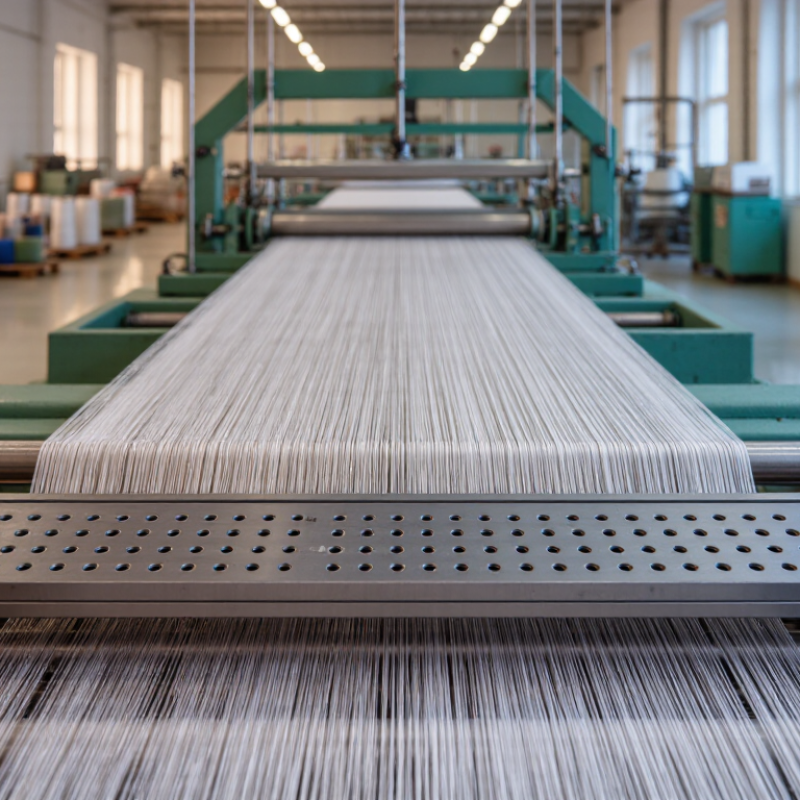
What a Jacquard Guide Board Does in a Weaving System
In a Jacquard weaving system, the guide board—often called a harness or comber board—organizes cords between the Jacquard head and the warp. Its holes keep individual cords in planned positions as they travel toward the heddles. It does not select warp threads; hooks and harness cords perform that lifting work. Alignment matters. Poor routing can cause rubbing, crossed cords, uneven tension, or visible marks in the cloth.
The board’s spacing should match the loom width, harness layout, and fabric design. During inspection, look for rough hole edges, cracks, and cords that pull at an angle. A small burr can gradually abrade a cord. Check the board under working tension, not only while the loom is stopped. Small part. Real consequences. Still, a guide board cannot correct worn cords, incorrect threading, or poor tension settings.
The scale makes reliable setup worthwhile. Textile Exchange’s 2024 Materials Market Report estimated global fiber production at 124 million tonnes in 2023, up from 116 million tonnes in 2022. Those figures describe the wider textile supply, not Jacquard-board performance. They do, however, underline the value of stable production. Record board dimensions and cord paths when changing a setup; local notes can prevent repeat misalignment. And be cautious: tighter spacing is not automatically better, since excessive contact may increase wear.
Confirm Loom Compatibility and Technical Requirements
A jacquard guide board must match the loom it will serve. Check the loom type, harness arrangement, hook count, and mounting points before comparing products. Then confirm the board’s length, width, thickness, and hole or slot pattern against the machine’s technical drawing. Small gaps matter. A board that looks close may still sit unevenly or interfere with moving parts.
Confirm the required operating speed and working conditions, including vibration, dust, and humidity. Ask for dimensional tolerances and material details, not just a general product description. If the board connects to an electronic control system, verify that its interface and signal requirements match the loom. Keep the machine’s serial or model details nearby, but do not assume a part fits based on those details alone. Drawings can be outdated.
Tip: Measure twice, including mounting-hole spacing and clearance around adjacent components. Compare those measurements with a current drawing, and request clarification when specifications are missing. A physical sample can help, though it may not reveal long-term wear. I would also record any uncertain dimensions before ordering. It feels slower, but it can prevent a costly mismatch.
Evaluate Materials, Construction, and Guide Precision
A jacquard guide board can look sound on a workbench and still cause trouble under tension. Check the base material for flatness, stable thickness, and resistance to moisture. Textile Exchange’s Materials Market Report 2024 estimates global fibre production reached 124 million tonnes in 2023, with polyester making up about 57%. That scale matters: synthetic yarns are widely used, but yarn type alone does not determine wear. Match the board surface and guide material to the yarn’s friction, lint, and operating speed. Small details matter.
Inspect construction under bright, angled light. Look for chipped guide openings, burrs, uneven coatings, and loose inserts. Run a clean yarn through several neighboring guides by hand; snagging or a sharp change in drag deserves investigation. Check the board’s mounting faces, too. A slight twist can shift guide alignment once bolts are tightened. I would not trust a visual check alone; measurements can reveal errors the eye misses.
Guide precision should be verified against the machine’s specified pitch and alignment, not a generic tolerance. Measure several positions across the board, including both ends and the center. Then confirm that guides sit squarely and maintain consistent clearance. Ask for inspection records, material specifications, and a repeatable measurement method. If documentation is thin, that is a real limitation—not proof of failure, but a reason to test a sample under representative yarn tension before purchase.
Compare Board Dimensions, Features, and Maintenance Needs
Before buying a jacquard guide board, measure the loom’s working area and compare it with the board’s usable width and length. Include clearance for mounting hardware, yarn paths, and nearby moving parts. A board that fits the frame may still crowd the threads. Check thickness and hole spacing too; these affect alignment and how evenly yarn travels. If dimensions are listed without tolerances, ask how they were measured.
Tip: Match the board to your setup, not just its headline size. Look for smooth, consistently finished openings and a stable mounting surface. Confirm that replacement parts or fitting instructions are available. If possible, inspect a sample under good light. Small details matter. A slightly rough edge can snag fine yarn, though I have seen this matter less with sturdier thread.
Maintenance needs deserve equal attention. Ask whether the material tolerates your usual cleaning method, and avoid assuming every finish handles moisture well. Dust collects quickly. Check whether lint can be removed from openings without scraping them, and whether fasteners stay accessible after installation. A quick weekly inspection may prevent uneven guidance, but the right schedule depends on use and room conditions. Keep a soft brush nearby, and note any wear before it changes thread movement.
Check Supplier Reliability, Warranty, and Total Cost
A Jacquard guide board must match the machine’s dimensions and operating conditions. Before ordering, ask the supplier for a dimensioned drawing, material details, and written confirmation of compatibility. A clear answer matters. Vague replies about fit or tolerances can lead to costly adjustments after delivery. Request photographs of the finished board and, when practical, a sample or inspection record. These details do not guarantee perfect performance, but they make expectations easier to verify.
Check how long the supplier has handled comparable components, and ask for references or examples of previous work. Then read the warranty carefully. Does it cover manufacturing defects, or only certain parts? Check the claim period, return shipping, repair process, and exclusions for installation or normal wear. Get the terms in writing. Small print can change the real value of a low quote.
Compare total cost, not just the listed price. Include freight, import charges where applicable, installation, alignment, spare parts, and possible machine downtime. A cheaper board may take longer to arrive or require extra fitting. Ask for a delivery estimate and confirm how replacement parts are sourced. I still find lead times easy to overlook. A simple cost sheet, with each charge listed, helps reveal what the quote actually includes.