
Choosing Led Spotlights looks simple until a bright beam lands on a glossy countertop or leaves a reading chair in shadow. The right choice depends on more than wattage. Beam angle, color temperature, color rendering, dimming compatibility, and fixture fit all affect what a room feels like. The U.S. Department of Energy’s Energy Saver guidance notes that LEDs use at least 75% less energy than incandescent lighting and can last up to 25 times longer. Those figures are useful, but they do not guarantee comfortable light. A spotlight can still feel harsh.
Lighting researcher Dr. Mariana Figueiro studies how light affects people and their daily rhythms. Her work highlights that light is a meaningful signal to the body’s circadian system. That perspective matters when selecting spotlights for bedrooms, kitchens, or work areas: brightness and color should suit the task and the time of day. Check the product’s specifications, then consider where the beam will actually fall. A narrow beam may pick out a framed print; the same beam can create distracting glare on a screen.
This guide offers seven practical tips for choosing Led Spotlights, from matching beam spread to checking dimmer support. Look beyond the box. Compare the beam angle, color temperature, and color-rendering information, and verify that the fitting suits your existing fixture. One detail is easy to miss: showroom lighting rarely matches a real room. A little uncertainty is normal. Test where possible, and be willing to rethink your first pick.
Start with the area and the light level you need. One lux equals one lumen per square metre. For a 12 m² reading area with a 300 lx target, you need 3,600 lumens reaching the surface. Treat this as a starting estimate, not a fixture specification. Light is lost or spread unevenly.
Tip: Check the beam angle and mounting height. A narrow beam can create a bright pool but leave nearby corners dim. A wider beam may cover more area, though its centre can feel less intense. For several spotlights, consider their combined output and spacing rather than simply dividing the target lumens by the fixture count.
Real rooms complicate the calculation. Dark walls, high ceilings, and furniture can reduce useful light, so the installed output may need to exceed the basic figure. A lux meter can help you check the result at desk or floor level after installation. I would recheck it at night, too; daylight can make a setup seem brighter than it is. The calculation is useful, but it cannot predict every shadow.

Choosing a beam spread starts with the size of the surface and the distance from the spotlight.
10°
A 10° optic creates a tight pool of light, useful for a sculpture, sign, or architectural detail. Its narrow beam can leave sharp bright spots and dark gaps if fixtures are spaced poorly. Aim carefully, especially on glossy surfaces where glare can distract.
25°
A 25° beam offers a practical middle ground for artwork, shelves, or a small planting bed. It covers more area without spreading light as widely as a 40° optic.
40°
A 40° beam suits broader targets, such as a wall section or low group of shrubs, but may spill beyond the intended area.
Check the footprint. Place a sample light at the planned mounting height, then observe the lit area from normal viewing positions. The beam’s edges may look softer in real spaces than they do on a specification sheet. That can be frustrating. Adjust the fixture angle or spacing before adding more lights, and consider whether overlapping beams create an even wash or unwanted hotspots.
CRI Ra is a useful starting point when comparing LED spotlights, but it is not a complete color-quality score. Under the CIE 13.3 method, Ra averages results from eight test colors. A spotlight rated Ra 80 may suit hallways or storage areas, while Ra 90 can show skin, timber, and textiles more naturally. That difference is visible. Yet a higher Ra does not guarantee that every color looks right.
The IES TM-30-18 method assesses 99 color samples, offering a broader view through fidelity and gamut measures. This matters when a narrow beam lights a painted wall or a bowl of ripe tomatoes. A fixture can have a strong Ra rating and still render certain reds or blues less convincingly. I have found that glossy finishes can make comparisons tricky, too.
For a fair check, compare lights on the same surface, at similar brightness, and under the dimmer setting you will actually use. Read the product’s Ra value, then look for TM-30 data such as Rf and Rg when available. The Illuminating Engineering Society’s 99-sample method provides more detail than Ra alone, though neither figure replaces a real-world test. Check the beam on your own materials. Small color differences can be easy to miss in a bright showroom.
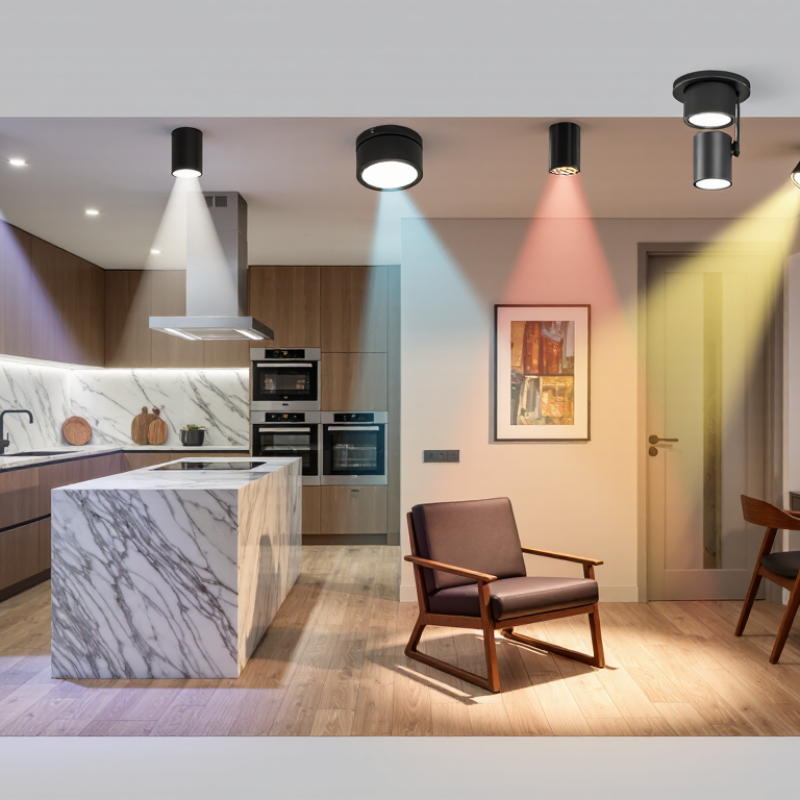
Tip: Match the light to the room’s use. Around 2700 K usually appears warm, like a softly lit living room. A 3000 K spotlight can feel less amber in kitchens or hallways. Near 4000–5000 K, light looks cooler and can reveal detail in work areas. These are useful starting points, not guarantees.
Use ANSI C78.377 as a comparison guide. It defines chromaticity ranges for solid-state lighting at nominal color temperatures, including values within 2700–5000 K. Check the stated CCT and chromaticity information, rather than relying on a color-temperature number alone. Two spotlights marked 3000 K may still look different. The standard helps assess color consistency; it cannot promise identical appearance in every room.
Tip: Test before fitting several fixtures. Aim one spotlight at a white wall, then at a wood surface or painted cabinet. Notice whether the color feels comfortable and whether nearby lights look consistent. Check the beam at the intended distance, too. A warmer setting may flatter a lounge but dull fine detail at a desk. I have found that a sample can look different once installed. That is worth checking.
| Nominal CCT | Typical Appearance | Common Applications | ANSI C78.377 Guidance | Selection Tip |
|---|---|---|---|---|
| 2700 K | Warm, soft white with a yellowish appearance | Living rooms, bedrooms, restaurants, and accent lighting | A nominal correlated color temperature (CCT) used for specifying LED chromaticity. | Choose it when a cozy, warm atmosphere is more important than a neutral-white appearance. |
| 3000 K | Warm white, slightly less yellow than 2700 K | Living areas, kitchens, hospitality spaces, and general residential lighting | A nominal CCT in the standard’s guidance for consistent chromaticity specification. | Consider it for a warm look with a little more visual clarity than 2700 K. |
| 3500 K | Neutral-to-warm white | Kitchens, work areas, retail spaces, and multipurpose rooms | A nominal CCT option between warm-white and cooler-white choices. | Use it when 3000 K feels too warm but 4000 K seems too cool. |
| 4000 K | Neutral white | Offices, workshops, kitchens, and utility areas | A nominal CCT used to define a target chromaticity range for LED products. | Choose it for a clean, balanced appearance in spaces used for detailed tasks. |
| 5000 K | Cool, daylight-like white | Garages, task areas, display lighting, and some outdoor applications | A nominal CCT option toward the cooler end of this 2700–5000 K selection range. | Consider it where a cooler appearance is desired; check that it suits the room and surrounding lights. |
Important: ANSI C78.377 provides chromaticity specifications and tolerances for solid-state lighting products; it does not prescribe which CCT to use in a particular room. Actual appearance can also vary with the light source, finishes, and surrounding illumination.
When choosing an LED spotlight, check what its IP rating actually covers. Under IEC 60529, IP65 means the enclosure is dust-tight and protected against water jets from any direction under specified test conditions. The first digit, 6, indicates no dust ingress during the test. The second digit, 5, indicates resistance to water jets. Not immersion.
That distinction matters outdoors. Rain or a routine hose-down may be within the intended protection, but IP65 does not mean the light can sit underwater or withstand every pressure washer. Nor does the rating guarantee resistance to corrosion, impact, or heat. These are separate considerations. A fixture near coastal air, for example, may need suitable materials as well as a sealed enclosure.
Check the complete spotlight, not just the housing description. Gaskets, cable glands, and the rear connection can become weak points if they are damaged or poorly fitted. Look for clear installation instructions, and keep seals clean when mounting the light. A tight screw can still pinch a gasket. It is an easy detail to miss. If the product will face direct jets or frequent cleaning, confirm the manufacturer’s stated conditions rather than relying on “waterproof” as a broad promise.
