
A tube may look like a simple steel profile, but cutting it accurately is demanding. A Laser Tube Cutter must coordinate the chuck, support system, laser head, and software while the workpiece rotates. Small errors can leave rough edges, misplaced holes, or scrap that must be handled again. These details matter in furniture, construction, automotive, and agricultural equipment production.
Market figures offer useful context, but they need careful interpretation. Grand View Research’s Laser Cutting Machines Market report estimated the global market at about US$5.1 billion in 2023 and projected continued growth through 2030. The report covers laser cutting machines broadly; it does not measure tube cutters alone. The World Steel Association’s April 2024 Short Range Outlook projected steel demand of 1,793 million tonnes in 2024 and 1,815 million tonnes in 2025. That wider demand provides context, not proof of sales for any single machine category. Still, a market estimate is not a factory audit.
This guide introduces ten Chinese manufacturers of laser tube cutting equipment. It considers practical factors such as supported tube shapes, cutting capacity, automation options, service coverage, and documented application experience. Buyers should verify specifications against their own materials, wall thicknesses, and production volumes. A machine’s advertised speed may not match a real shift. That deserves scrutiny. The companies below offer different capabilities, so the strongest choice depends on the work—not just the catalogue.
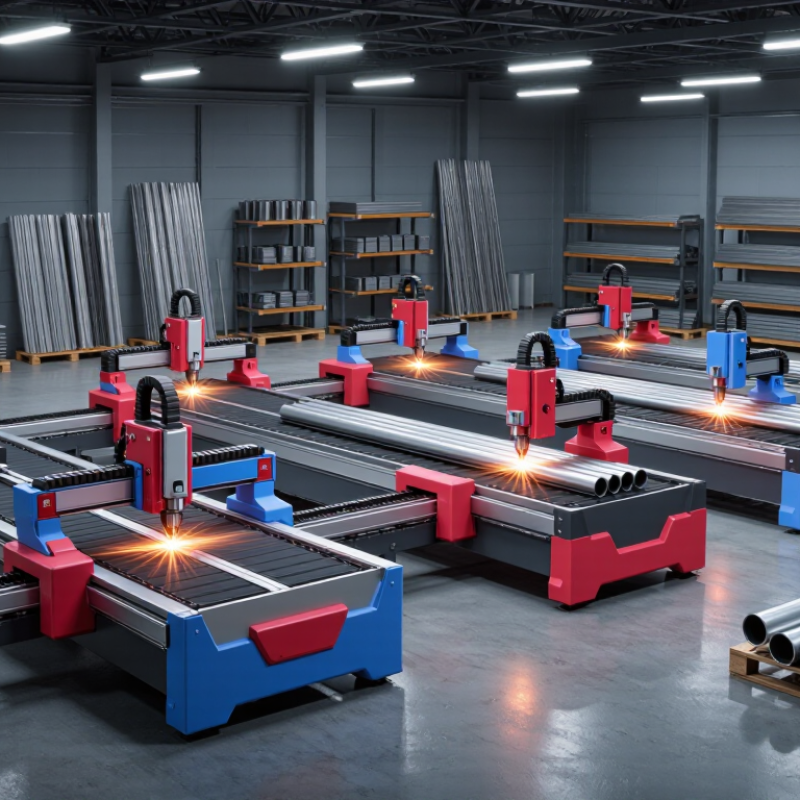
A laser tube cutter shapes round, square, and rectangular metal profiles without a saw blade. A chuck grips and rotates the tube while a CNC-controlled head moves along its length. A focused fiber-laser beam heats a narrow path; assist gas pushes molten material out, leaving the cut edge. The machine can pierce holes, cut slots, and trim angled ends in one setup. That is the core. In practice, results depend on tube alignment, material thickness, focus, and gas settings.
Automation matters, but it is not a shortcut around process control. The International Federation of Robotics’ World Robotics 2024 report recorded 541,302 industrial robot installations worldwide in 2023. That figure describes industrial robots broadly, not tube cutters specifically, but it reflects the wider move toward automated production. A tube system may add automatic loading and unloading, yet poor calibration can still cause drift, burrs, or wasted stock. Real shops are less tidy than diagrams suggest.

China’s laser tube-cutting industry is best understood as a layered supply chain, not a simple ranking of machine builders. Upstream suppliers provide laser sources, cutting heads, control systems, chucks, and precision drives. Machine manufacturers integrate these parts into systems for round, square, and open-profile tube. Downstream, distributors and automation integrators help factories connect cutters with loading, unloading, and production software. The split is practical. A machine’s output depends on the whole line, not just its laser power.
The 2024 China Laser Industry Development Report put China’s laser-equipment market at about RMB 91.2 billion in 2023. That figure covers laser equipment broadly, not tube cutters alone. It signals a substantial industrial base, but it should not be mistaken for tube-cutter sales. Automation is another influence: the International Federation of Robotics reported 276,288 industrial-robot installations in China in 2023, around 51% of global installations. On a factory floor, that trend can mean a tube cutter paired with robotic handling, reducing manual repositioning between cuts. Yet integration quality varies. A fast cutting head cannot fix poor tube alignment or weak process planning. That detail is easy to overlook.
Industry-structure overview, not a ranked supplier list. Company and brand names are intentionally omitted; machine configurations and supplier responsibilities vary.
| Industry Layer | Typical Role | Products or Capabilities | How It Connects to Tube Cutting | Useful Evaluation Criteria |
|---|---|---|---|---|
| 1. Complete-machine builders | Design, assemble, test, and sell finished tube-cutting systems. | Machine frame, motion system, laser integration, cutting enclosure, and machine-level controls. | Coordinate the major subsystems into a production-ready machine and define its supported configurations. | Cutting demonstrations, machine specifications, installation support, warranty terms, and availability of spare parts. |
| 2. Laser-source suppliers | Provide the laser generator used to create the cutting beam. | Fiber laser sources and associated power, cooling, and connection requirements. | The source is integrated with the cutting head and machine controls; suitable power depends on material, thickness, and process requirements. | Rated output, service arrangements, compatibility, maintenance requirements, and documented operating limits. |
| 3. Cutting-head suppliers | Provide optics and beam-delivery components at the cutting point. | Laser cutting heads, focusing components, protective windows, and height-sensing interfaces. | The head follows the programmed cutting path while maintaining the required focus and standoff conditions. | Supported source configuration, consumable availability, sensing features, and ease of maintenance. |
| 4. Motion and CNC-control suppliers | Enable coordinated machine movement and execution of cutting programs. | CNC control, servo drives, motors, motion components, and machine-control interfaces. | Coordinate the cutting head, tube rotation, feed axes, and process commands according to the machine design. | Axis coordination, programming workflow, diagnostic tools, control-system support, and integration quality. |
| 5. Tube chuck and rotation systems | Grip, rotate, and position the workpiece during processing. | Chuck assemblies, rotation drives, clamping mechanisms, and workpiece-support components. | Accurate and repeatable tube positioning is essential for cutting features around the tube circumference. | Supported workpiece geometry, clamping range, loading method, positioning repeatability, and changeover needs. |
| 6. Loading and unloading automation | Move raw tubes into the machine and finished parts out of the cutting area. | Bundle loading, automatic feeding, unloading, part handling, and optional material-transfer equipment. | Automation can reduce manual handling and support longer production runs when matched to the workpiece mix. | Supported tube dimensions and weights, loading cycle, floor-space needs, safety provisions, and integration with the machine. |
| 7. CAD/CAM and nesting software | Convert part designs into machine-ready cutting instructions and production layouts. | Tube-part programming, feature definition, nesting, process settings, and program output. | Software links design data to cutting operations and can help manage material use and production sequencing. | File compatibility, ease of programming, post-processor support, nesting functions, and operator training. |
| 8. Machine-frame and component suppliers | Supply structural and mechanical parts used in the finished system. | Frames, beds, guards, guideways, electrical cabinets, and supporting mechanical assemblies. | These components contribute to machine rigidity, alignment, safety, and long-term serviceability. | Build quality, assembly and alignment procedures, guarding, documentation, and replacement-part support. |
| 9. System integrators and application engineering | Configure machines and processes for a customer’s parts and production workflow. | Process trials, workholding choices, automation integration, factory layout, and production-line connections. | Integration work helps ensure that the machine, software, material handling, and downstream operations work together. | Relevant application experience, sample-part validation, project scope, commissioning plan, and acceptance criteria. |
| 10. Distributors and after-sales service | Support equipment selection, delivery, installation, training, and ongoing maintenance. | Local sales support, commissioning, operator training, troubleshooting, and access to service parts. | Service coverage affects machine uptime, especially when the end user is located far from the manufacturing site. | Service response arrangements, technician availability, spare-parts access, training, and escalation procedures. |
For a fair comparison of China’s leading laser tube cutter manufacturers, start with the work the machine must actually perform. Check its supported tube diameters, lengths, wall thicknesses, and profile shapes against your own production mix. Ask for a sample cut using your material, then inspect the edge, burrs, and hole position under consistent conditions. A polished demonstration is useful, but a repeatable result matters more.
Production claims need context. Grand View Research estimated the global laser cutting machines market at USD 5.65 billion in 2023 and projected a 7.5% compound annual growth rate from 2024 to 2030. This signals a competitive, expanding sector, not proof that any one supplier is dependable. Compare stated cutting speed with tested output, setup time, material waste, and downtime. For cut quality, ISO 9013 offers a useful framework for assessing thermal-cut surfaces and tolerances. Ask how results were measured.
Support is easy to overlook. Request details on commissioning, operator training, spare-part availability, and response times, preferably in writing. Check the machine guarding, extraction provisions, and maintenance access during a factory visit. Look closely. A scoring sheet helps, yet it can hide trade-offs: a lower purchase price may mean slower support or higher upkeep. I would leave room for judgment.
China’s laser tube cutter sector includes manufacturers with different strengths, rather than one standard solution. These ten capability-based profiles help buyers compare options; they are not an audited ranking. One manufacturer may focus on compact machines for small workshops. Another may offer enclosed systems with automated loading. A third may emphasize cutting thin-walled stainless steel. A fourth may build equipment for large-diameter tubes. A fifth may provide flexible fixtures for varied profiles.
Details matter.
A sixth manufacturer may prioritize production speed, while a seventh may focus on stable cuts and reduced scrap. An eighth may offer straightforward controls for operators learning the process. A ninth may support custom layouts for existing factory floors. A tenth may provide broader service and spare-parts coverage.
These distinctions need verification. Ask for sample cuts using your actual tube material, wall thickness, and drawing files.
Inspect edge quality, corner accuracy, and loading time—not just the advertised cutting speed. Request clear information about installation, training, and maintenance response.
A neat demonstration is useful, but it cannot show every production problem. Some comparisons may still feel incomplete; that is a reason to ask better questions, not to assume every machine performs alike.
When comparing China’s top 10 laser tube cutter manufacturers, treat rankings as a starting point, not proof of performance. Check the cutting head, chuck design, tube-loading system, and supported diameter range against your actual workpieces. For example, test a 6-meter steel tube with the wall thickness you process most often. Ask for a sample cut, then inspect kerf consistency, burrs, and cut-end squareness. Request operating data for your material, not just a polished demonstration. Vague specifications matter.
Tips: Compare the same tube size, material, and cut pattern across suppliers. Record cycle time, scrap, and operator adjustments. Ask who provides training and how quickly replacement parts can ship.
Service can shape uptime as much as machine speed. Clarify installation scope, remote support hours, warranty exclusions, and the availability of common consumables. For cost, compare the full package: machine, software, freight, setup, training, and expected maintenance. A lower quote may omit useful tooling or leave commissioning costs unclear. Speak with a recent customer if possible, and ask what needed adjustment after delivery. Brochures can miss details; shop-floor feedback may change the picture.
