Top 10 Jelly Roll Assembly Suppliers Worldwide?
Jelly Roll Assembly sits at the center of modern lithium-ion cell manufacturing. It winds coated electrodes and separators into a compact structure. Small alignment errors can create wrinkles, edge damage, or inconsistent resistance. Quality is decided before the finished cell leaves the line.
Market pressure is increasing. The International Energy Agency reported that global battery demand for electric vehicles exceeded 750 GWh in 2023, rising by roughly 40% year on year. The same report estimated global cell manufacturing capacity above 2.5 TWh. BloombergNEF recorded an average lithium-ion battery pack price of $115 per kWh in 2024, down 20% from the previous year. These figures show why suppliers are investing in faster winding, cleaner handling, inline inspection, and tighter process control.
As battery scientist Dr. Jeff Dahn has stated, “The battery is the most important component of an electric vehicle.” His point applies directly to Jelly Roll Assembly. A reliable supplier must control tension, tab placement, separator tracking, and machine uptime. It must also provide traceable service after installation. This guide examines ten leading suppliers worldwide, considering equipment capability, production scale, technical support, and documented industry experience. A perfect ranking is impossible. Public data remains uneven, and some suppliers disclose far more than others. Therefore, readers should treat this list as a practical starting point, not a final purchasing decision. A factory visit still reveals details that brochures often hide: cable routing, operator access, dust control, and the condition of a running winding station.
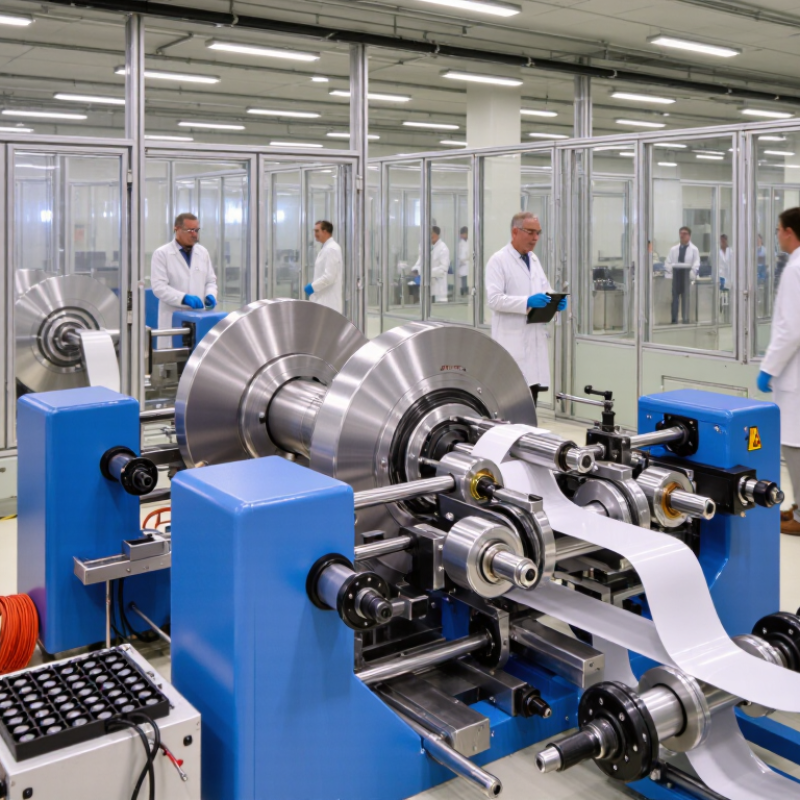
Jelly Roll Assembly: Definition, Structure, and Core Manufacturing Processes
Jelly Roll Assembly: Definition, Structure, and Core Manufacturing Processes
A jelly roll assembly is the wound electrode core inside many cylindrical rechargeable cells. It combines a positive electrode, negative electrode, and two separator films. These layers are stacked, aligned, and tightly rolled around a central mandrel. The finished roll resembles a compact spiral, but its internal alignment controls electrical performance and safety.
Manufacturing begins with precise electrode slitting and surface inspection. The winding machine then controls tension, speed, and edge position. Small alignment errors can create wrinkles, exposed edges, or uneven pressure. After winding, the assembly is compressed and inserted into a metal casing. Current-collecting tabs are welded to the correct terminals. Insulating components prevent accidental contact. Electrolyte filling, sealing, formation charging, and leak testing follow under controlled conditions. In practice, no production line is perfect. Even a stable process needs regular measurement and corrective review.
Tips: Check separator overlap, winding tension, tab placement, and core diameter at every key stage. Use vision inspection and electrical testing together. One method can miss hidden defects. Record temperature, humidity, and weld resistance because these details affect long-term reliability. Suppliers should also verify traceability from raw material batches to final cell testing. A rushed inspection may save minutes, but it can weaken confidence in the entire assembly.
How to Evaluate Global Jelly Roll Assembly Suppliers
Top 10 Jelly Roll Assembly Suppliers Worldwide?
How to Evaluate Global Jelly Roll Assembly Suppliers
Choosing a jelly roll assembly supplier requires more than comparing prices. Examine winding accuracy, separator placement, electrode alignment, and tab welding quality. Ask for process capability data, not only attractive samples. A reliable supplier should explain its inspection points clearly. Measure thickness, resistance, moisture levels, and dimensional tolerance during pilot production. Small deviations can affect cell performance later.
Visit the facility when practical. Look for controlled clean areas, calibrated equipment, trained operators, and clear material flow. Review traceability records from incoming materials to finished assemblies. Each batch should have a readable identification system. Request evidence of adhesive control, insulation protection, and weld strength testing. Production capacity also matters, but unused capacity is not proof of readiness. Confirm staffing, equipment redundancy, and realistic delivery schedules.
Technical communication often reveals more than a sales presentation. Ask how the supplier handles design changes, failed samples, and urgent quality issues. Their answers should include owners, timing, and documented corrective actions. Check export experience, packaging methods, and after-sales support across your target markets. A polished audit can still miss problems. I have seen excellent reports hide weak floor discipline. Use independent testing for critical samples, and leave room for human error in your evaluation. No scorecard is perfect. Reassess the supplier after scale-up, not only during qualification.
Top 10 Jelly Roll Assembly Suppliers by Capabilities and Market Focus
The top 10 jelly roll assembly suppliers should be compared by capability, not visibility. A practical ranking includes high-volume cylindrical specialists, large-format prismatic lines, pouch-cell integrators, and flexible pilot-line providers. Other strong profiles focus on tab welding, precision winding, dry-room handling, automated inspection, or contract manufacturing. This separation matters because battery designs differ sharply in electrode width, winding tension, separator control, and tab geometry. The IEA Global EV Outlook 2025 reports that battery demand for electric vehicles exceeded 1 TWh in 2024. That scale rewards suppliers with stable automation and measurable process control.
Market focus also changes supplier value. Some providers serve electric vehicles, while others target energy storage, power tools, medical equipment, or aerospace systems. BloombergNEF’s 2024 Battery Price Survey placed the average lithium-ion pack price at 115 dollars per kWh, with LFP packs near 83 dollars. Cost pressure therefore favors suppliers that reduce scrap, shorten changeover time, and detect wrinkles before sealing. Leading candidates should disclose winding yield, alignment tolerance, line speed, and traceability depth. Quiet details matter.
A weakness remains. Public rankings rarely reveal customer-specific yield data or warranty results. My assessment would therefore score the ten supplier profiles across equipment flexibility, safety validation, regional service, and production scale. The “best” supplier may not have the fastest line. It may have the cleanest process records and the quickest response when a separator shifts by a fraction of a millimeter. Supplier capability changes quickly, so this ranking should be reviewed annually.
Supplier Comparison: Quality, Capacity, Customization, and Delivery
Top 10 Jelly Roll Assembly Suppliers Worldwide?
A reliable supplier comparison should examine quality, capacity, customization, and delivery equally. Quality begins with controlled winding, accurate separator alignment, clean workspaces, and consistent weld strength. Ask suppliers for inspection records, process tolerances, and sample data from recent production. Factory experience matters more than impressive brochures. It shows in stable dimensions and fewer rejected cells.
Capacity must match your forecast, not just your pilot order. Review daily output, equipment redundancy, staffing, and expansion plans. Customization may include electrode dimensions, tab placement, winding tension, insulation, and packaging.
Strong suppliers document engineering changes and protect traceability. Delivery performance deserves similar attention. Confirm material lead times, production slots, inspection time, and shipping buffers. A low quoted lead time can hide serious risks.
Tips: Request three sample assemblies. Measure alignment, burr control, and compression after handling. Visit the facility when possible. Speak with quality engineers, not only sales staff. No scorecard is perfect. A supplier may achieve excellent quality but lack backup equipment. Another may offer high capacity with weaker customization controls. Weigh each weakness against your product’s risk. Keep written acceptance criteria, and review them after every trial batch. Small details, such as labeling accuracy and response time, often predict the delivery experience better than a polished presentation.
Key Applications and Future Trends in Jelly Roll Assembly Manufacturing
Top 10 Jelly Roll Assembly Suppliers Worldwide?
Jelly roll assembly is a critical stage in cylindrical and pouch battery production. It combines coated electrodes and separator film into a compact, aligned structure. In practical manufacturing, tension control matters greatly. A slight wrinkle can create uneven pressure, lower energy density, or increase internal resistance. Small errors matter.
These assemblies support electric vehicles, energy storage cabinets, power tools, medical equipment, and portable electronics. Each application requires different winding speeds, dimensions, and quality limits. Vehicle batteries often demand high throughput and consistent alignment. Stationary storage systems may prioritize cycle life and thermal stability. Operators inspect edge position, winding tension, tab placement, and insulation quality during production. Clean handling is essential because dust can damage performance.
Future jelly roll assembly lines will rely more on machine vision, robotic loading, and closed-loop tension control. Sensors can detect film drift within milliseconds and adjust the winding path automatically. Digital production records will improve traceability between raw materials and finished cells. Artificial intelligence may predict defects before they become visible, although calibration remains difficult. The process is not flawless. False alerts can slow production, while poor data can mislead engineers. Manufacturers are also exploring lower-waste designs, faster changeovers, and flexible equipment for new cell formats. Solid-state battery development may eventually require different winding methods, sealing systems, and material handling practices.
Top 10 Jelly Roll Assembly Suppliers Worldwide: Key Applications and Future Trends
The chart presents an industry-level view of the main application segments for jelly roll assembly equipment and an indexed outlook for automation adoption. The application figures are shown as an illustrative global demand mix, while the trend index uses 2024 as the baseline value of 100.
Electric vehicles remain the dominant application, followed by energy storage and consumer electronics. Future manufacturing priorities include higher winding precision, inline inspection, faster changeovers, digital traceability, and increased automation.